Blog Archive

Followers

Come Reason's Apologetics Notes blog will highlight various news stories or current events and seek to explore them from a thoughtful Christian perspective. Less formal and shorter than the www.comereason.org Web site articles, we hope to give readers points to reflect on concerning topics of the day.

Powered by Blogger.

Tuesday, January 13, 2015

Is There Such a Thing as Christian Terrorism?

The recent attacks on the French satirical periodical Charlie Hebdo resulted in a worldwide outpouring of support for the victims and condemnation of the terrorists. But the condemnation also came with a lot of confusion and rhetoric from both liberal and conservative factions. I don't believe it is right to paint all Muslims with the terrorist brush. As John A. Azumah explained in his recent piece, the Wahabbists follow a specific type of Islam, but they also shirk their own authority structures and seek to take matters into their own hands.1 Thus, the terrorists are both the natural outworking of Islamic beliefs and violators of its governing bodies.


While some on the right may have a penchant to see every Muslim as a terrorist, some on the left make two very different types of errors. The first is to see no connection between the terrorists and Islam at all. This is absurd to the point of ridicule. After Mohammad's conquering of Medina and Mecca, the Caliphite expansion across North Africa and into Spain, the Crusades, the Ottoman expansion, the attack on the Marine base in Lebanon, the attack on the USS Cole, 9/11, the London Subway bombings, the Madrid train bombings, and countless more attempts that have been thwarted, I think that any reasonable person can see a pattern developing. History shows that Islam was in fact spread by the sword, and it is easy to see how the children of the Hanbali tradition would see justification in continuing that tradition.

But it is the other mistake some have made that concerns me even more deeply. There are some on the left who would argue that it isn't Islam that's the problem, but it is any type of dedicated religious belief. These people charge that Christians who take their faith seriously are just as much a terrorist threat as radicalized Muslims.

One case in point is an article written by Jack Jenkins that appeared on the Think Progress site a month before the Charlie Hebdo attack. Entitled "The Other Kind Of Religious Extremism: The Christian Terrorist Movement No One Wants To Talk About," Jenkins tries to link individual attacks, such as the white supremacist Larry McQuilliams who shot up several buildings (but no people) in Austin, Texas with groups like Al Queaeda, Boko Harem, and ISIS.

Jenkins knows that McQuilliams was following the teachings of the white supremacist group the Phineas Priesthood. But for him, that's more evidence that some Christians can be dangerous. He writes, "McQuilliams' possible ties to the Phineas Priesthood may sound strange, but it's actually unsettlingly common. In fact, his association with the hateful religious group highlights a very real — but often under-reported — issue: terrorism enacted in the name of Christ." 2

Wait a minute. Did Jenkins really enact terrorism in the name of Christ? Did he scream out "Jesus be praised" during his attack? Not at all. According to the Austin Chronicle, who interviewed FBI special agent Chris Combs, "he had a rooted motive. 'He could not find employment,' Combs said. 'He was also upset that – in his eyes – many immigrants had more services afforded to them than he had afforded to him.'"3 Yet, Jenkins is pretty quick to rush his judgment simply because he had a book published by a white supremacist movement with the word "Christendom" in the title. Jenkins then shows his hand by widening his scope:
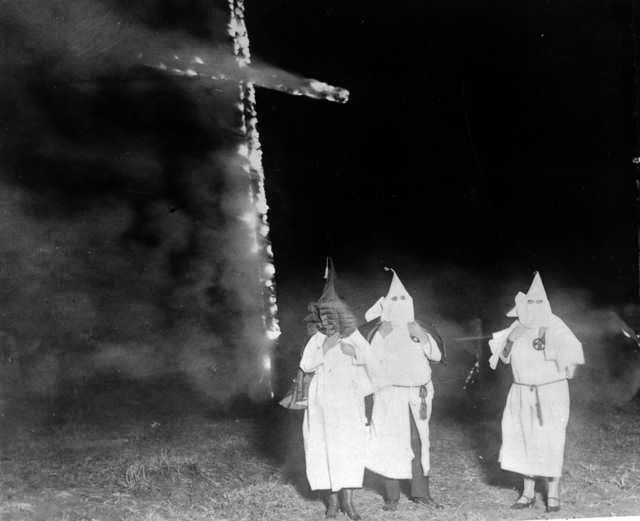
But there is a long history of terrorist attacks resembling McQuilliams' rampage across Austin — where violence is carried out in the name of Christianity — in the United States and abroad. In America, the Ku Klux Klan is well-known for over a century of gruesome crimes against African Americans, Catholics, Jews, and others — all while ascribing to what they say is a Christian theology.4
Is he kidding? "All while ascribing to what they say is Christian theology?" Jenkins uses the IRA of Northern Ireland as one example of "terrorism enacted in the name of Christ." That's ridiculous; the IRA was very much a political group, described as "a militant nationalist organization" by the Encyclopedia Britannica.5 There was no ascribing their actions as the proper outworking of Christian theology. Likewise, the Klu Klux Klan cannot claim any verse that tells them to burn crosses or hang people because of the color of their skin. In order to demonize Christianity, Jenkins simply tries to grab hold of anything that seeks to use the word "Christian" while violating both the core teachings of Christianity and the example set by its founder, Jesus Christ.

When looking at the foundation of Christianity, one sees that the followers of Jesus died for their faith, and even during those times of early persecution they didn't form an army against their persecutors. The inherent worth of all men including those with physical or mental defects comes from Christianity. The teachings of Jesus such as the Golden Rule, to go the extra mile, or to "turn the other cheek" are the best values for a civilized and gracious society. Jesus Himself did not conquer with an army, but gave himself as a sacrifice for others. If an individual's acts with intent to terrorize or kill, you no longer have Christianity. You have something else entirely.

In perpetrating intentional distortions such as these, Jenkins himself engages in a kind of journalistic terrorism, seeking to ghettoize the faithful followers of Jesus as some kind of threat. The public would be better served with the truth than misleading articles such as his.

References

1. Azumah, John A. "An Explanation of Islam's Relation to Terrorism and Violence." First Things. First Things, Jan. 2015. Web. 13 Jan. 2015. http://www.firstthings.com/article/2015/01/challenging-radical-islam.
2. Jenkins, Jack. "The Christian Terrorist Movement No One Wants To Talk About." ThinkProgress. ThinkProgress, 4 Dec. 2014. Web. 13 Jan. 2015. http://thinkprogress.org/justice/2014/12/04/3599271/austin-shooter-christian-extremism/.
3. Hoffberger, Chase, and Michael King. "Shooter Had ‘Hate in His Heart'" The Austin Chronicle. The Austin Chronicle Corp., 5 Dec. 2014. Web. 13 Jan. 2015. http://www.austinchronicle.com/news/2014-12-05/shooter-had-hate-in-his-heart/.
4. Jenkins., Think Progress, 2014.
5 "Irish Republican Army (IRA) | Irish Military Organization." Encyclopedia Britannica Online. Encyclopedia Britannica, n.d. Web. 12 Jan. 2015. http://www.britannica.com/EBchecked/topic/294148/Irish-Republican-Army-IRA.

Monday, January 12, 2015

Are you Ready to Argue Like Jesus?

Are you ready? Do you have what it takes? Are you prepared to argue? Christians today face more opposition to their beliefs than in the past. Those people are going to assert them to us. Therefore, we need heed the charge of the Apostle Peter who commanded that we always be ready to make a defense for our hope in the gospel (1 Pet. 3:15). One way to do this is to learn to argue well.


For many people, that last sentence sounds counter-intuitive. "Didn't your mother tell you it isn't nice to argue?" they may ask. Others think it's downright anti-Christian to argue. But, neither of these responses are true; and that's because when I use the word argument, I mean something different from what they're hearing. When I say the word "argument," I don't mean two people yelling at one another or hurting each other's feelings. I mean something completely different; and it has more to do with growing your understanding than raising your voice.

Why It's Impossible to Avoid an Argument

All people have beliefs. You can't be a functioning human being and not hold to at least some beliefs. Some of them are easily identified, such as "I'm alive right now" or "I'm reading this blog post." Others are a bit more complex, such as one's belief in the existence of God or which political party has better answers for his or her country, yet all these beliefs have some kind of reasoning behind them. It may be that you investigated the data or it may be that you were taught a belief from a young age. The authority figure or your study helped form your beliefs. There are a few beliefs that are self-presenting, like the belief that I am not in pain right now. I know I'm not feeling pain because pain experience is direct and immediate. However, most of our beliefs are formed through other means.

Because each one of us has beliefs, each one of us holds to certain things we believe are true about the world. A belief is simply that, something we take as true about the world. Those beliefs will also shape my actions and reactions to situations around me. If I believe in the power of prayer, that belief is going to play itself out in the action of my praying. If I believe that an unborn baby is made in the image of God, then that will shape my political views on abortion. Your beliefs will always spill out into your actions and touch the people and institutions you come in contact with.

There's the issue, though. Because different people hold different views about the world, it should be no surprise that you will run into people who don't believe things that you hold as true and they believe things you hold as false.  Such contacts mean two people will desire different outcomes to a specific situation, each believing that his or her outcome is the correct one. Just like two cars that are traveling in opposite directions arrive at a one-lane bridge simultaneously, both cannot go on their merry way until the conflicting desires are resolved.

Preparing to Argue Like Jesus

Because you, dear Christian, have reasons for your beliefs, and everyone will face beliefs that conflict with their own, it becomes crucial that you make sure you are better prepared to engage those conflicts. That requires you to learn to argue well. As I said at the top of this post, arguing doesn't mean yelling, fighting, or hurting someone's feelings. Arguing is simply discussing your beliefs with another person, but doing so by providing reason and evidence, or as Michael Palin defined it: "An argument is a connected series of statements intended to establish a proposition." It means we talk and support our belief with the reasons why we think that such a belief is true.

As I've been saying, this is exactly the way Jesus did it. The Gospel of Luke tells us that "The Child continued to grow and become strong, increasing in wisdom; and the grace of God was upon Him" (Luke 2:40). Jesus in his human nature grew in knowledge. He learned how to speak, and he learned the beliefs of his day. Jesus quoted the Scriptures – do you think he studied them? Do you think he worked at memorizing them? Do you think Jesus was a good student?  Did He study hard? He certainly seemed to know the beliefs of the Sadducees and the Pharisees as he put both to shame in Matthew 22.

I invite you to join me for the next few days as I lay out what well-structured arguments look like, and how you can make them. I also want to show what fallacies are, both to help you avoid them and to pick them out if your opponent should use them. Learn to argue more effectively; you will be following in the footsteps of Jesus.

Saturday, January 10, 2015

Apologetics is Foundational Since the Earliest Times of the Faith

It should be the goal of every Christian to reflect the heart of Jesus in his or her life. Yet, some in the church bristle at the idea of equipping themselves to defend the faith against ideas raised against it. They assume apologetics to be an intellectual game, where they would rather take the path of Jesus and model love. However, as I've shown, Jesus integrated apologetics into much of his ministry.

Here, Dr. Craig Hazen notes that the apologetics task has been exemplified in every ambassador who sought to introduce a lost world to the Creator. He writes:
It is very important to understand that in justifying the task of Christian apologetics throughout the history of the church, it was Jesus himself who set the stage. He did this not by writing apologetic tracts and treatises but by creating what I shall call here an "ethos of demonstration" among his followers. Jesus demonstrated the truth of his message and his identity over and over again using nearly every method at his disposal, including miracle, prophecy, godly style of life, authoritative teaching and reasoned argumentation' And although Jesus clearly authorized the apologetic ethos for his followers by living it out himself, it is also important to note that he did not create this approach ex nihilo during his three years of ministry. Indeed, Jesus was really just reaffirming an ages-old ethos of demonstration that had been well established in the Old Testament tradition. From the miracles of Moses in Pharaoh's court (Ex 7) to Elijah's contest with the prophets of Baal (1 Kings 18) to God himself calling for his opponents to "present your case ... set forth your arguments" (Is 41:21), a divine pattern was already fixed by the time Jesus came on the scene.1.
1. Hazen, Craig J. "Defending the Defense of the Faith." To Everyone an Answer: A Case for the Christian Worldview: Essays in Honor of Norman L. Geisler. Francis Beckwith, William Lane. Craig, and James Porter Moreland, Ed. Downers Grove, IL: InterVarsity, 2004. 37. Print.

Friday, January 09, 2015

Two More Arguments Against Homosexual Marriage

Many pundits are stating that 2015 will be the year the Supreme Court of the United States (SCOTUS)  will take up the question of homosexual marriage. With conflicting rulings from different federal courts of appeal, it seems more than likely. But SCOTUS doesn't have to rely on religious beliefs alone to understand why allowing homosexual marriage is a dangerous precedent for a society to set. Once can look at the behavior and the political issues that the concept of marriage involves to argue that protecting natural marriage is more beneficial to the citizens of the state than redefining marriage to any and all comers.


The Behavioral Question

I've previously written on biological and medical arguments against homosexual marriage that I believe are incredibly strong and demonstrate how natural marriage is more than just a way to share a life with someone you love. Yet people argue that individuals have the right to define marriage as they see fit. They share the opinion of Chip Arndt and Reichen Lehmkuhl, the self-proclaimed "married" homosexual couple who won CBS' game show The Amazing Race. Arndt noted the Oxford dictionary definition of marriage encompasses only a man and a woman. He then commented, "What's happening today, which has always happened through any revolution of culture, is that people redefine words. And we're basically saying-
Reichen: It's time to redefine.
Chip: It's time to redefine it."1

I've said before that heterosexual marriage is necessary to survival of a culture and how the concept of marriage as we now understand it is incompatible with same sex unions. What many don't realize is many in the homosexual community who do want to redefine marriage intend to change the concept well beyond the boundaries of which sexes are involved.

Even today, looking at homosexual couples who identify themselves as monogamous or committed, one finds a modification of those concepts. In the Australian and New Zealand Journal of Sociology, scientists studying homosexual relationships noted "Gay monogamous relationships are rarely faithful. 'Monogamous' seems to imply some primary emotional commitment, while causal sex continues on the side."2

Another study of homosexual partnerships was conducted by German "Sexologist" and homosexual Dr. Martin Dannecker. In 1991, Dannecker studied 900 homosexuals in 1991 living in what they defined as "steady relationships". However, Dannecker found that 83% of those males had numerous sexual encounters outside their partnerships over a one-year period. Dannecker then concluded that the "clear differences in the manner of sexual gratification" between single and non-single gay men were the reverse of what he expected. Of the homosexual men in steady relationships, he wrote, " the average number of homosexual contacts per person was 115 in the past year." In Contrast, single gay men had only 45 sexual contacts.3

Such a radical departure from the concept of two people entering into a lifetime commitment is both shocking and dangerous. Promiscuity is understood as a high-risk behavior carrying dire consequences, not the least of which are health related. In fact, an upscale homosexual men's magazine, Genre, surveyed 1037 readers in October of 1996. Here are some of the results: "One of the single largest groups in the gay community still experiencing an increase of HIV are supposedly monogamous couples." 52% have had sex in a public park. 45% have participated in three-way sex. 42% have had sex with more than 100 different partners and 16% claim between 40 to 100 partners.4

Of course there are those who want to do away with the concept of marriage being a union between two individuals altogether. In a Los Angeles Times article,  the head of the International Gay & Lesbian Human Rights Commission, Paula Ettelbrick, was interviewed and asked about her views on the same-sex marriage controversy. Ettelbrick, who is also a law professor, "recommends legalizing a wide variety of marriage alternatives, including polyamory, or group wedlock. An example could include a lesbian couple living with a sperm-donor father, or a network of men and women who share sexual relations."5 The article goes on to discuss how one of her goals, in Ettelbrick's words, is to "push the parameters of sex, sexuality and family, and in the process transform the very fabric of society."6 Such changes to the concept of marriage do nothing to alleviate the high-risk behavior in which homosexuals engage and, according to Dannecker's study, may actually enflame such behaviors.

The Political Question

Ultimately, it becomes important to understand why marriage is encouraged within the laws of the United States. As I've written before, the marriage relationship is seen as so necessary that "every human societ[y] has had to promote it actively".7  This means that the welfare of the society depends on the active encouragement of monogamous heterosexual unions. When understood this way, one can make a case that the U.S. constitution requires the definition of marriage to remain as it now stands.

First, we must understand that homosexuals are not being denied equal rights to marry whomever they want. The restrictions regarding marriage are enforced equally to both the heterosexual and homosexual population. For example, neither homosexuals nor heterosexuals can marry a sibling. In the same way, no one can marry someone of the same sex - that proscription applies to all citizens equally and is therefore not discriminatory.

So, why does the government restrict marriage at all? The opening paragraph of the U.S. Constitution is known as the Preamble, and it sets forth the overarching principles of what the document is designed to accomplish. It reads "We, the People of the United States of America, in order to form a more perfect union, establish justice and ensure domestic tranquility, provide for the common defense, promote the general welfare and secure the blessings of liberty to ourselves and our posterity do ordain and establish this constitution of the United States of America."8

Note that the writers explicitly state its purpose is to promote the general welfare for the people of the United States and their posterity. But I've demonstrated that homosexual marriage is in conflict with this. It wouldn't promote the general welfare of the society - it would hinder that process! Therefore, it does not make sense to say homosexual marriage is a constitutional freedom. How can we usurp this foundational intent of the framers that's explicitly stated in the constitution itself with something that is nowhere mentioned as a right?

Philosopher Francis Beckwith, in his article "Wedding Bell Blues; Understanding the Same-Sex Marriage Debate" sums it up thusly, "Since marriage is an intrinsic good, just as justice is an intrinsic good, a culture that does not nourish, encourage, and protect traditional marriage will do so at its own peril, just as it would imperil itself if it no longer understood justice as an intrinsic good. … Republican (small "r") government results from good citizens civilized by the institutions of family, honest work, and good religion. If, to quote Aristotle, statecraft is soulcraft, then the end of the state should be to produce good citizens and therefore provide a privileged and protected position for these institutions. The state, consequently, should treat traditional marriage as privileged and protected in contrast to other alternatives."9

Beckwith states that the purpose of government really defines its role regarding marriage. If the state is interested in making good citizens and promoting the good, then marriage must be protected as a heterosexual union. He continues "On the other hand, a state that treats all alternative lifestyles as equal does not believe that statecraft is soulcraft and is therefore not particularly interested in producing good citizens qualified to engage in republican government. Such a state denies there is any such thing as the good, the true, or the beautiful."10  The founding fathers have demonstrated that the government of the United States was formed for a higher purpose, that qualities such as establishing justice, promoting the welfare of the people and ensuring that their posterity also enjoyed those assurances. Since homosexual marriage endangers society in real ways and is antithetical to those ends it cannot be considered constitutionally protected. It does, in fact, undermine the intent of the constitution itself.

References:

1.Advocate.com Editors. "Married and Millionaires-amazing!" Advocate.com. Here Media, Inc., 21 Aug. 2003. Web. 09 Jan. 2015. http://www.advocate.com/news/2003/08/22/married-and-millionaires%E2%80%94amazing-0?page=0%2C1.
2. Connell, RW. Crawford, J., Dowsett, GW., Kippax, S., Sinnott, V., Rodden, P., Berg, R., Baxter, D., Waston, L., "Danger and context: unsafe anal sexual practice among homosexual and bisexual men in the AIDS crisis" Australian and New Zealand Journal of Sociology (1990 ) 26: pp.187-208.
3. Wittmeier, Carmen. "Now They Know The Other Half." Alberta Report 7 June 1999: 27. Print.
4. "Sex Survey Results," Genre (October 1996), quoted in "Survey Finds 40 percent of Gay Men Have Had More Than 40 Sex Partners," Lambda Report, January 1998, 20. Print.
5. Rivenburg, Roy "Divided over Gay Marriage" Los Angeles Times 12 March 2004. E1. Print.
6. Ibid.
7. Young, Katherine K. and Paul Nathanson "Marriage a la mode: Answering the Advocates of Gay Marriage"
http://www.marriageinstitute.ca/images/mmmode.pdf Sept. 29, 2003
8. The United States Constitution
9. Beckwith, Francis J. "Wedding Bell Blues: Understanding the Same-Sex Marriage Debate - Christian Research Institute." Equip.org. Christian Research Institute, 22 Apr. 2009. Web. 09 Jan. 2015. http://www.equip.org/article/wedding-bell-blues-understanding-the-same-sex-marriage-debate/.
10. Ibid.

Thursday, January 08, 2015

What Islam Really Teaches About Images of Muhammad

The world is in shock at the grave tragedy in which twelve people were gunned down at Charlie Hebdo by Muslim extremists. The French satirical newspaper had published several cartoon caricatures of the Islamic prophet Muhammad over the years, many of them placing the prophet in scandalous or obscene positions.


Islamic activist and Sharia law lecturer Anjem Choudary seemed to justify the attack in a USAToday Opposing Views piece where he said that freedom of expression "comes with responsibilities" and explained that "the potential consequences of insulting the Messenger Muhammad are known to Muslims and non-Muslims alike."1 He seems to place the emphasis on the satirical aspect of the portrayals rather than the fact that these were images of Muhammad. However, it's being reported that any depiction of Muhammad is banned in Islam. A CNN report entitled "Why Islam forbids images of Mohammed" wrote that "The prohibition again illustrating the Prophet Mohammed began as an attempt to ward off idol worship." They also note the prohibition extends to other prophets and noted that "some Muslim countries banned the films Noah and Exodus this year because their leading characters were Hebrew prophets."2

But that's not quite what Islam teaches.

No Images of Any Living Creature

To be clear, there is no prohibition whatsoever against images of the prophets in the Qur'an. The closest one gets is Sura 21:52 where Abraham rebukes the idol worship of his people with the question "What are these statues to which you are devoted?"3 However, it isn't only the Qur'an that informs the religion of Muslims. Muslims must also rely on the traditions of Muhammad, as recorded in a series of books known as the Hadith. There are different Hadith for different factions of Muslims, but most Muslims are Sunni by far and their Hadith bans not simply depictions of Muhammad or the prophets, but any visual representation of any person or animal is forbidden!

One such Hadith has Muhammad rebuking a woman who purchased a pillow for him to recline upon because it had images of people on it:
Narrated ‘Aisha: (the wife of the Prophet)

I bought a cushion having pictures on it. When Allah's Apostle saw it, he stopped at the gate and did not enter. I noticed the signs of hatred (for that) on his face! I said, "O Allah's Apostle! I turn to Allah and His Apostle in repentance! What sin have I committed?" He said, "What about this cushion?" I said, ‘I bought it for you to sit on and recline on." Allah's Apostle said, "The makers of these pictures will be punished (severely) on the Day of Resurrection and it will be said to them, ‘Make alive what you have created.'" He added, "Angels do not enter a house in which there are pictures." (Sahih Bukhari, Book 72, Number 844)4
Another Hadith has Muhammad stating, ""Angels do not enter a house in which there is a dog or there are pictures." (Sahih Bukhari, Book 72, Number 833)5 According to an article on Answering-Islam.com, Muslim scholars both ancient and recent have concluded that anyone making depictions of living creatures will be required by Allah to breathe life into them on the Day of Resurrection. When one cannot, that person will be punished for idolatry. 6 The article goes on to state that: "'No pictures' includes no photos (still or moving). ‘No pictures' might reduce idolatry, but the reason given is not that, but that Allah will torment all who have made pictures" and "No pictures in the home includes no television in the home."7

The prohibition on images in Islam is wide and sweeping. The Answering-Islam article notes that for some reason while images on a pillow are banned, Muhammad didn't have a problem with little girls playing with dolls.8 This makes little sense as the doll makers are certainly doing the same thing as sculptors or pillow manufacturers. Also, most Muslims today don't seem to ban television or cameras from their homes.

The ban on images is simply one more way to underscore the fragmented nature of the teachings of Islam. The press misunderstands the ban and in some ways helps justify the offense in the eyes of the west by limiting it to some kind of attack only on the holiest figures of the Islamic faith. That is a misrepresentation, since even a harmless depiction of an anonymous individual is not allowed. Choudary allowed the USAToday web site to publish his Op-Ed with images of people accompanying the piece. He also has his own web site that shows his picture.  Such actions show the hypocrisy of his stance.

References

1. Choudary, Anjem. "People Know the Consequences: Opposing View." USA Today. Gannett, 08 Jan. 2015. Web. 08 Jan. 2015. http://www.usatoday.com/story/opinion/2015/01/07/islam-allah-muslims-shariah-anjem-choudary-editorials-debates/21417461/.
2. Burke, Daniel. "Why Islam Forbids Images of Mohammed." CNN. Cable News Network, 8 Jan. 2015. Web. 08 Jan. 2015. http://edition.cnn.com/2015/01/07/living/islam-prophet-images/index.html.
3. "Surat Al-'Anbyā' (The Prophets) - سورة الأنبياء." Qur'an.com. Qur'an.com, n.d. Web. 08 Jan. 2015. http://quran.com/21/52.
4. Hadith, Sahih al-Bukhari, Book 72, Number 844. Center for Muslim-Jewish Engagement. University of Southern California, n.d. Web. 08 Jan. 2015. http://www.usc.edu/org/cmje/religious-texts/hadith/bukhari/072-sbt.php#007.072.844 .
5. Hadith, Sahih al-Bukhari, Book 72, Number 833. Center for Muslim-Jewish Engagement. University of Southern California, n.d. Web. 08 Jan. 2015. http://www.usc.edu/org/cmje/religious-texts/hadith/bukhari/072-sbt.php#007.072.833 .
6. "Are Pictures of Muhammad Really Forbidden In Islam?" Answering Islam. Answering Islam, n.d. Web. 08 Jan. 2015. http://www.answering-islam.org/Muhammad/pictures.html.
7. Answering Islam, Ibid.
8. Answering Islam, Ibid.

Wednesday, January 07, 2015

What's Wrong with Just Telling Boys "Don't Slap Girls"

Boys don't want to slap girls. At least that's what the popular YouTube video entitled "'Slap her': Children's reactions" shows. Produced in Italy, the short clip shows several boys aged 10 to 11 in front of a young girl where they dutifully perform requests such as "make a funny face" or "caress her" from an off- camera voice. However, when each is told "slap her", none comply. When asked why they won't slap her one says, "Because you're not supposed to hit girls!" while another replies "I don't want to hurt her."1


I applaud the boys for not hitting the girl. It's decent; and I've given the same instruction to my boys. However, I worry that the video doesn't prove what it sets out to. In fact, I think that the underlying assumption is more problematic than meets the eye.


The video has been promoted as a demonstration that violence against women is wrong. ABC News's San Francisco affiliate wrote "Italian media company fanpage.it created the video to show how both violence and pacifism can be taught at an early age."2 But what does it show? Of course, pre-pubescent boys after being instructed to tell a girl how pretty she is and to stroke her don't then follow instructions to slap her. Is that a surprise?

Juxtapose this to this is the famous Milgram experiments. These are well-known experiments in psychology where people believed they were administering electric shocks to participants (really actors pretending to hurt) and when commanded, they would obey authorities even to the point of sending a shock that could be fatal.3 While Milgram's experiment had some flaws, a more recent iteration proved that people were more than willing to obey an authority who told them to provide a painful electric shock to a stranger. The study found "People who were normally friendly followed orders because they didn't want to upset others, while those who were described as unfriendly stuck up for themselves."4

Commands in Isolation are Not Beneficial

I think both findings show the flaw in moral commands that are not grounded in a larger worldview. The Italian video may be trying to say that young children don't want to slap girls by nature, but that isn't necessarily true. Kids who know and disagree with one another will get into fights all the time, and unless specifically instructed by a parent, may slap someone of the opposite sex. Also, they obviously are taken with the pretty girl and hitting her wouldn't make sense. But Milgram-type experiments do show that some people are more than willing to inflict pain when ordered to do so.

The kids seemed to understand that hitting a girl is wrong because boys are stronger than girls and could do more damage to them. Men do have significantly more muscle mass than women, leaving women much more vulnerable in a confrontation between individuals of opposite sexes. Yet, in today's "biology doesn't matter" culture, we're told the differences between the sexes don't matter, except when they do.

Morality Rooted in Worldview

More broadly, what our kids require is not simple rules, but an understanding of the value of human beings and why men shouldn't hit women. The Christian world view teaches that anyone who is in a position of strength—be it physical, financial, or influential—should not use that position to take advantage of another person made in the image of God. It is through Christianity that we understand the equality of all people and it gives us good reasons for acting civilly towards one another. In fact, such an approach also tells us that women are as valuable as men in our society and therefore should be held in high regard.  But when right and wrong are reduced to whatever the adult or some authority figure says, people may be manipulated to do horrendous things, as Hitler's Germany has proven.

I don't know if the kids in the video understood the full moral grounding of why we shouldn't hit a girl. In the video, one boy responded that "Jesus doesn't want us to hit others," which isn't a bad answer. But as parents, we need to teach our children not simply what to do and not do, but how all of that relates to the larger picture of God and man. Once that foundation is established, individuals are less likely to be swayed, and are better equipped to weigh their actions in a variety of contexts, making better decisions even in unforeseeable situation. Isn't that how we want to rear our children?

References

1. "Slap Her": Children's Reactions. Prod. Fanpage.it. YouTube. YouTube, 4 Jan. 2015. Web. 07 Jan. 2015. https://www.youtube.com/watch?v=b2OcKQ_mbiQa.
2. "VIDEO: Young Boys Asked to Slap Little Girl in Social Experiment." ABC7 San Francisco. ABC, Inc., 5 Jan. 2015. Web. 07 Jan. 2015. http://abc7news.com/society/video-young-boys-asked-to-slap-little-girl-in-social-experiment/462246/ .
3. McLeod, Sam. "Milgram Experiment." Simply Psychology. Simply Psychology, 2007. Web. 06 Jan. 2015. http://www.simplypsychology.org/milgram.html.
4. Shim, Eileen. "Psychologists Have Uncovered a Troubling Feature of People Who Seem Nice All the Time." Mic. Mic Network, Inc., 30 June 2014. Web. 07 Jan. 2015. http://mic.com/articles/92479/psychologists-have-uncovered-a-troubling-feature-of-people-who-seem-nice-all-the-time.

Tuesday, January 06, 2015

How to Have a Justified Belief

The concepts of belief and knowledge are woefully confused today by both Christians and non-Christians. Some of this has to do with anti-theistic rhetoric made popular by the New Atheists, some is the prevalence of Internet memes that make slick sounding but fallacious charges, and some is just the general ignorance. For example, here's how Christopher Hitchens tried to separate himself from beliefs:
And here is the point, about myself and my co-thinkers. Our belief is not a belief. Our principles are not a faith. We do not rely solely upon science and reason, because these are necessary rather than sufficient factors, but we distrust anything that contradicts science or outrages reason. We may differ on many things, but what we respect is free inquiry, openmindedness, and the pursuit of ideas for their own sake.1
First of all, everyone has beliefs. For Hitchens to say that he doesn't have a belief is simply ridiculous. He believes he should not rely on science and reason alone and he believes he should distrust other forms of knowledge that contradict them.  His entire book is a treatise on what he believes and what he believes you should believe, too! So, let's set aside any nonsense that one can hold to facts without beliefs. As I showed yesterday, any claim of knowledge requires one to believe that the claim is true.


Yesterday, I was asked, "To what degree do you think it's possible to be 'belief-free'?" It's simply impossible to be belief free, since beliefs are a core part of our knowledge. The famous philosopher Rene Descartes developed a thought experiment where he tried to doubt everything. He even doubted his own senses, considering the possibility that they may be manipulations of a deceiving spirit (think the Matrix).  But he found that he couldn't doubt the fact that he was doubting! He had at least found one belief—that he was capable of thinking and doubting—he held to always be true.

What is a Justified Belief?

All people hold beliefs, but that doesn't mean that all beliefs are equal. There is a difference between a justified belief and an unjustified belief. For example, I may mention to you that I believe a certain sports team will win in the playoffs this year. You would naturally ask, "Why do you believe that?" If I respond with statistics about the team or how they have performed against their opponent, you would know that my belief isn't based on nothing, but I've come to my conclusion using information appropriate to make a decision. Even if you disagree with me, you wouldn't say my belief was arbitrary. It is rational given the facts presented. My belief is justified. It was derived based on relevant data, and it is not an unreasonable conclusion.

However, if I were to tell you that the team will win because I picked them out of a hat, or I liked their team colors, or even because they are "my team," then you could conclude that my belief is not justified. Team colors or a person's allegiance doesn't affect the outcome of a professional sporting match. They have no influence on the performance of the players.

Of course, there are degrees of justification, too. The strength of the facts presented and how well the belief explains other things we know give a belief more justification than one that rests on just a few facts. Roderick Chisholm breaks justification into six degrees of positive belief (Certain, Obvious, Evident, Beyond Reasonable Doubt, Epistemically in the Clear, and Probable) and defines each one to show how one belief may be stronger or weaker than another.2

One Cannot Justify Science and Reason without Belief

All people have beliefs and some of those beliefs concern how one understands God, life, and the world around us. These are important beliefs, as they make up our worldview. If one's beliefs can be shown to be justified and they don't contradict one another, then that person has a coherent worldview.  Hitchens' has a problem, however. He holds that science and reason are good and beliefs are bad. Yet, one cannot have science or reason without beliefs. That means that Hitchens' worldview is contradictory; he wants to reject beliefs and uphold rationality when rationality forces one to choose whether to believe a claim or not.

Beliefs matter and they are fundamental to knowledge. To discount belief is to know nothing at all.

References

1. Hitchens, Christopher. God Is Not Great: How Religion Poisons Everything New York: Twelve Books, 2007. Kindle Edition. 8.
2. Chisholm, Roderick M. Theory of Knowledge. Englewood Cliffs, NJ: Prentice-Hall, 1989. Print. 8-17.

Monday, January 05, 2015

You Can't Be an Atheist Without a Belief

It all started with a tweet.

Yesterday, I tweeted:
The idea was to provide an example of the distinction between the terms agnostic and atheist. As I said before, this idea that one can be both an atheist and an agnostic makes no sense. Of course, not everyone who identifies as an atheist or as an agnostic believes that one can be an "agnostic atheist," but the concept has become more and more popular, even though it’s nonsense. My tweet was what I thought a simple way to demonstrate that.


Then the atheists responded.

One tweeted:
Uh, sure. But that doesn’t solve the problem. Breaking down the prefix of the words does nothing to show how an atheist can also be an agnostic. The "without" of agnosticism doesn’t mean "without a positive belief in," it means "without any beliefs for or against." It means you either don’t know or cannot know. Either way, one cannot be an atheist and hold that God does not exist.

Philosophers understand that claiming to have any kind of knowledge about a thing, you must hold to some beliefs about that thing. Using my football example, if I claim to know that  Team X will not make it to the Superbowl, that knowledge must be predicated on the belief that they will not be victorious in the conference final against Team Y, or something like that. If I have a belief it is either that they will win or they will lose. Knowledge requires that I have some kind of belief. Therefore, if one holds no beliefs, such as my neutrality regarding football playoffs, then one cannot make a claim to know about them.


Give that background, I received this response:
What followed was an extended Twitter conversation where I tried to show how knowledge requires belief. Feel free to read it. I think a lot of this confusion stems from how many "atheists on the street" mis-define knowledge and belief. They seem to confuse knowledge with facts and belief with feeling.Thus I had one atheist tell me:

That's confused. If you believe that your team will win the Conference finals, you may hold that belief based on their previous record, the analysis of the opposing team, and other factors. You may know know they will will, but you can certainly believe so, based on the facts.

Yet, some people persist in mis-defining agnosticism, atheism, knowledge, and belief. It’s why one atheist actually said:
To which I replied: "You believe that you don't have any beliefs! That's at least one."

Sunday, January 04, 2015

How We Are Created in the Image of God? (Video Clip)

There seems to be a lot of confusion people have over the biblical teaching that man is created in God's image. Some falsely believe it means that God must be a human being with a body.  However, this cannot be right as God has revealed himself as a spirit.


In this short clip, Lenny explains just what the phrase "created in God's image" means and lists several specific attributes that only humans and God share. For more on this idea, see the Come Reason article "How is Man Created in the Image of God?"

Saturday, January 03, 2015

How Modern Society Turns Virtue into Vice

Our culture today has lost the concept of virtue. As I've written before, colleges have placed feelings above values, and relativism above moral responsibility. Because the only thing now considered wrong is the critique of another's actions, the concept of virtue has nearly disappeared from Western society. We feign virtuousness by boasting of our tolerance and demand a society where no one's choices are called out as illegitimate. But that misunderstands the very nature of virtue.


In this short quote below, J. Budziszewski explains just what virtue is:
If I said, “The excellence of a knife is its sharpness,” you would know what I meant: sharpness is the specific quality that enables a knife not just to cut, but to cut excellently. Another word for excellence is virtue. So you would also know what I meant if I said the virtue of an eye is clearness or that the virtue of a racehorse is swiftness. Clearness is what enables an eye to see excellently, swiftness is what enables a racehorse to race excellently. Once again we have a formula. A virtue or excellence of a thing (there may be more than one) is the specific quality that enables it to perform its function or proper work excellently and so achieve its highest good.

Like our last formula, this one too can be applied to mankind. How do we know whether a particular human quality, such as courage or ruthlessness, is a virtue or not? The proper work of a human soul is using and following reason. So the quality is a virtue only if it helps it to do so excellently. For instance, one virtue is theoretical wisdom, the discipline of mind which helps us reason our way to truth while avoiding error; another is practical wisdom, the discipline of mind which helps us reason our way to good choices while avoiding evil.

But here we run into a problem. It looks at first as though the only true virtues are intellectual ones. What about moral virtues, such as courage, justice, self-control and friendliness? Isn't there a place for them? Yes, for two main reasons. To understand the first one, remember that more than one thing is active in the human soul: not only the power of reasoning itself but also the power of feeling and the power of desiring. … Just as the intellectual virtues discipline the thoughts, the moral virtues discipline the feelings and desires. An example of moral virtue that disciplines the feelings is courage, whereas an example of moral virtue that disciplines the desires is self-control.

To sum up, the main reason the intellectual virtues are not the only virtues is that different virtues are needed to put each of the different powers of the soul in rational order. The second main reason is that different virtues bring the soul into rational order in different respects.1
Virtue is lost in our society because we no longer look at the entire person and his purpose for existence. Modern culture has elevated feeling above reason; the action or critique is wrong because it makes someone feel bad or it stifles his desire. Instead, one must understand what it means to be an excellent human being, which encompasses both intellectual and moral excellence. To not approach human excellence holistically turns tolerance into a vice, not a virtue.

References

1 Budziszewski, J. Written on the Heart: The Case for Natural Law. Downers Grove, Ill: InterVarsity, 1997. Print. 26-27.

Friday, January 02, 2015

Back to the Future and the Existence of God

We made it! It's finally 2015, that famous year Marty McFly visited in the 1989 Back to the Future sequel. For years, Internet blogs and commentators have been waiting to see the hoverboard, flying cars, and the Nike self-lacing shoes. Some of these are actually getting closer to being a reality, while others may never be seen.


I've always been interested in the way people envision the future. It actually says a lot about humanity. Sometimes, sci-fi writers get things pretty accurate; Jules Verne's submarines and Star Trek's flip phone/communicators are prime examples. But other times they get things terribly wrong. Two such predictions can be seen in Back to the Future II: flying cars and a fax machine in every room. The reason for this is not technological. Both flying vehicles and fax machines exist today. Instead, there are other considerations that come into play.

For me, there are significant parallels in the way people misunderstand the future and the way unbelievers misunderstand God. Using the flying cars and the fax machine examples from the movie, Let's briefly look at two ways people get God wrong.

People Overestimate Themselves

Let's begin with the flying car example. People have been predicting them almost as long as the Wright Brothers safely touched down at Kitty Hawk. But there are some incredible dangers that are attached to flying. First of all, safe driving requires the attention of the driver. But if you've ever commuted to work, you know that as people become more comfortable with their daily routines, they tend to over-estimate their ability and begin to drive and eat, drive and put on make-up, or drive and text.

With flying cars, however, there wouldn't be merely a single plane of traffic flowing horizontally, but there would be multiple planes where other vehicles could approach yours. Cars could merge from above, below, or diagonally. This is why we currently use air traffic controllers who watch all the planes in the sky and direct traffic. Now, imagine the millions of vehicles we use to commute all take to the skies. Who will make sure everyone is behaving appropriately in the sky? What kind of risk would a "crazy driver" place you in in the air? And, as Christopher Neiger notes, if your flying car breaks down, it will fall out of the sky and you can't drive them if the weather's bad.1

Similarly, when I talk with people about the existence of God, they over-romanticize their view of what God should or shouldn't do based on a very limited viewpoint. Some will say a God of love would never allow such and such. But God knows a whole lot more about us, our future, and our choices than we do. I don't think these pictures of God are taking into account how issues of human freedom work, the problems of all other world views,  and they underestimate the true immorality of most people.

People Underestimate the Glory of God

Another classic scene in BTTF II is when Marty McFly is fired from CusCo and fax machines all over the house relay the message. We look back and laugh at the scene now. While most folks yearn for a flying car, not really thinking through all the dangers they bring, I know of no one who is demanding a fax machine in every room! But in 1989, fax machines were still considered a great business innovation; no longer did you have to wait for documents to be sent via mail, but they could be instantly transported to anywhere as long as the recipient had a machine of his own. It would be natural that such technology would extend to the home environment.

Then the Internet happened.

With email and scanners, fax machines are redundant. Add to that laptop computers, wireless connectivity, and the ability to go online via your mobile phone, and fax technology is pretty much obsolete. It is actually a hassle for most people to retrieve a fax unless they sign up for a service that delivers it to their email account. But, we can't blame the script writers of BTTF II for not predicting the online explosion that we've experienced in the last 15 years. The underlying communications structure of the Internet, TCP/IP, was only beginning to be established in the late 80s2, and the Tim Berners-Lee wouldn't invent the language of the World Wide Web for another year.3

I believe many people suffer from the same problem with believing in God. In his book, Faith of the Fatherless: The Psychology of Atheism, Paul Vitz offers the "Defective Father Theory" and provides many examples of notable atheists throughout history who had such difficult relationships with their father than partially caused them to see God in a similar light.4 Other people cannot grasp how one can be happy and still live without whatever specific vice they desire to hold on to. Still more cannot see that the world to come will be much more glorious than anything we can envision today. Their view of heaven is just a bigger version of the world they now experience; they see a fax machine heaven instead of an Internet one.

As we jump into 2015. I pray that you would be open to God's leading in your life. Don't underestimate His love for you nor overestimate your need for Him. Perhaps this year won't take you where you anticipated. That's OK. It may very well be that God has a much better plan for your life than you can foresee. And you may be able to use these ideas to share God's love with others. While movies like Back to the Future are fun, they really do offer a way to open conversations about issues of eternal consequence.

References

1. Neiger, Christopher.  "Top 5 Reasons You Don\u0027t Want a Flying Car"  03 October 2011.  HowStuffWorks.com. Web. http://auto.howstuffworks.com/5-reasons-you-dont-want-flying-car.htm 02 January 2015.
2. Stewart, William. "TCP/IP Internet Protocol." Living Internet. William Stewart, 1996. Web. 02 Jan. 2015. .
3.
W3C. "Tim Berners-Lee." W3C. W3 Consortium, 10 Sept. 2014. Web. 02 Jan. 2015. http://www.w3.org/People/Berners-Lee/.
4 Vitz, Paul C. Faith of the Fatherless: The Psychology of Atheism. Dallas: Spence Pub., 1999. Print.
Image courtesy Ewen Roberts and licensed under the Creative Commons Attribution 2.0 Generic (CC BY 2.0)

Tuesday, December 30, 2014

2014 Top Ten Apologetics Blog Posts

This year the Apologetics Notes blog has really exploded. I switched to a daily post format, and you all have responded by continuing to come back to read the various articles and topics that we talk about. There are well over 20,000 pages read every month and the audience is growing daily.


The growth is also reflected in the most popular blog posts, all of which were published in the second half of the year. Some posts are straight apologetic while others, such as the Ann Coulter piece or the Hillsong article, focus on topical events. But every one was enthusiastically shared across social media.

Without further adieu, here are the ten most popular blog posts of 2014:

Article Pageviews
10 Conflicting Beliefs of Modern Atheism 2805
The Missing Piece in the Hillsong Controversy 2255
Christianity is a Thinking-Man's Faith 1812
Why Naturalism is Simply Unbelievable 1284
Morality Relies Upon God's Character, Not Simply His Commands 1176
Atheist insults believers and is stunned at the result 1093
Atheists contradict themselves by seeking invocations 994
History Testifies that Jesus Worked Miracles 701
Ann Coulter is Wrong-People are More than Numbers 691
One Reason Why Jesus Cannot be Mythical 684

Monday, December 29, 2014

Get Smarter by Practicing Doing Nothing

Soon, we will begin a new year and all the weight loss ads will appear. Some will ask you to join a gym while others will promise amazing results with little or no effort on your part. Since inactivity is part of the cause of weight gain, I would hope that people would approach such claims with great skepticism. However, there is a way you can improve yourself that takes little to no physical exertion whatsoever. In fact, to improve you will have to limit your activity quite stringently. You need to practice doing nothing.


As many have noted, we live in an age of distraction. Our world is a noisy one, with video screens and always-connected capabilities robbing us of any time alone with our thoughts. We have become more and more dependent on such distractions, as one study found "Ninety five percent of American adults reported that they did at least one leisure activity in the past 24 hours, such as watching television, socializing, or reading for pleasure, but 83% reported they spent no time whatsoever 'relaxing or thinking.'" 1 So it's no wonder that the researchers found that most people found sitting in a chair and thinking for ten to fifteen minutes was not an enjoyable experience and a significant number chose to administer small, painful electric shocks to themselves rather than simply think about something. 2,3

Deep Thinking Versus Distracted Thinking

You may jump to the conclusion that it's the younger generations that are more incapable of uninterrupted thinking, but in "Just think: The challenges of the disengaged mind", Timothy Wilson and his co-authors found that the age of the participant (ranging from 18 to 77) or whether they performed the test at home or in a lab setting made no difference. The only real difference in helping people "gain better control of their thoughts with meditation and other techniques, with clear benefits."4

I agree that deeply thinking about a particular problem or issue is a lost skill and one that every believer should seek to cultivate. The Psalms are replete with commands for us to meditate on the Scriptures and the works of God5 to help us better understand Him and our place in the world. Therefore, I want to offer some tips on ways you can practice thinking about an issue more deeply. These are just ways I try to approach certain problems I mull over as I work through them.

1. Ensure You're Exposed to Rich Ideas

The first step in thinking well requires you to get in the habit of taking in ideas that you may not have previously been exposed to. The best way to do this is to develop a habit of reading. You don't have to read for huge chunks of time, but simply read regularly. Plan in getting ready for bed and spend the last 30 minutes every evening reading. This will help you wind down from the day and it will also improve your sleep. You should read actively, with a pencil in hand and marking up your books. If you disagree with the author, write it in the margin. If you think a point is confusing, note that too. You don't have to look up a word or reference at this point, just read. Choose some classic works of fiction and choose some non-fiction. Mix it up. You'll find that there are many different ways people approach certain issues. All of this helps you to think about ideas in different contexts.

2. Mull over the ideas to which you've been exposed.

Next, pick a particularly intriguing or difficult idea and start thinking through it. You should do this at a different time than your reading. Morning is always good. In my devotional time, I try to meditate on a different aspect of God's character each morning. I've taken a list of the different names of God and use it to contemplate that aspect of his character. I really try to think about what it means for God to be the Lord Our Banner. What aspects of God does such a title reflect? How do those aspect impact me in my walk? This is my very first action in my morning prayer time.

With other ideas, I usually try to find a time where I will have limited distractions to think over an issue. The key is to focus on one thing. How does that idea fit in with your understanding of the world? Does it have implications for other beliefs that you hold? What are three reasons to reject such an idea? Would such a concept be true under any circumstance? Can you outline an argument in your head for or against that view? Who else would be considered an expert in that topic and have you looked at what they would say? All of these questions will help you explore that topic much more deeply than simply taking the author's word for a particular point of view.

3. See how your previous ideas work with your new thoughts.

Lastly, as you take in new ideas, you'll want to see how well those mesh with previous ideas you have. Are there any points of connection? Sometimes, new insight will be gained by taking two ideas that seem disparate and trying to connect them in some way. For example, I was once reading an opinion piece lamenting the fact that the candidates for the various offices in the city of Los Angeles were almost exclusively male. The pundits were decrying this as a travesty, making the point that women add a voice and an influence that men cannot replicate. I was also working on some questions about same-sex marriage and it really struck me how if each sex offers unique views that are necessary to the well-being of governance, then it should be more true that two parents of different sexes offer unique views that are necessary to the well-being of any children that are raised, which prompted this post.  However, that's just one example of how new ideas can form when you think about an issue more deeply and carefully.

References

1. Wilson, Timothy D., et. al.  "Just Think: The Challenges of the Disengaged Mind." Science 4 July 2014: 75-77. Print.
2. Wilson, 2014, 76.
3. Pomeroy, Ross. "Some People Prefer Electric Shocks to Thinking Quietly by Themselves" RealClearScience. RealClearScience, 13 July 2014. Web. 29 Dec. 2014. http://www.realclearscience.com/blog/2014/07/some_people_prefer_electric_shocks_to_thinking_quietly_by_themselves.html.
4. Wilson, 2014. 77.
5. For examples, see Joshua 1:8, Psalm, 1:2, Psa. 4:4, Psalm 77:6, Psalm. 119:23-27, Psalm. 145:5.

Sunday, December 28, 2014

Is Christmas a Pagan Holiday? (Podcast)

Every Christmas and Easter the charge is made that these holidays were originally pagan celebrations that Christians usurped for their own purposes. Is this true? Are Christmas and Easter nothing more than an attempt to convert unbelievers by allowing them to keep their festivals? As the holiday season approaches, we'll show why such a charge can be easily dismissed.


Saturday, December 27, 2014

Why Thinking About God Matters

Philosopher Greg Ganssle on the "big questions" of life and why thinking about God matters:
Why think about God? After all, no one knows whether there is a God, much less which God is real. Well, I am not as sure as you that no one knows. If God exists, then he knows, to be sure. He would have no identity crisis. Besides, we ought not claim that no one knows that there is a God until after we have done our thinking about God. So one reason to bother thinking about God is to see if you can find good reasons to think that there is a God. Another reason is to see if you can find good reasons to think there is no such person as God.

There are other reasons to think about God besides trying to figure out if there is such a person. What you believe and think about God affects nearly every area of your life. Many of the big and deep questions that shape how each of us sees the world are very closely related to questions about God. For example, it is a big and important question whether life has any meaning or purpose other than whatever meaning we give it ourselves. If we push this question very far, we will wind up thinking about God. If there is a God who created us and knows us, then whatever purpose we have will probably be related to whatever purpose he has for us. Another big and important question has to do with the nature of moral reality. Are there things that are right or wrong regardless of the opinions of others? Again, if God has a purpose for us, it might be that his purpose involves our living up to or reflecting moral reality. You can see that the question of God is a central question. If we want to think well about our lives, we will want to do some of our best thinking about God.
From Ganssle, Gregory E. Thinking about God: First Steps in Philosophy. Downers Grove, IL: InterVarsity, 2004. Print. 16.

Friday, December 26, 2014

2014 Top Five Apologetics Podcasts

The Come Let Us Reason Together podcast has continued to grow in 2014, seeing an average of nearly 1,700 downloads a month as we approach the end of the year. Part of Some of the increasing popularity has come from people interested in listening to previous podcasts, a task that was made much easier since we have redesigned the podcast page and integrated it into the comereason.org site.


Of the popular topics for 2014, two of them ("Tools for the God-Fearing Mind" and "Science, God, and Knowing") deal with some complicated issues. Yet, these made it into our top five. Some others deal with questions that you hear from skeptics and the top podcast topic is one we've approached before: how to understand and witness to Muslims.

Here, in reverse order of popularity, are the top five podcast topics of 2014.
  1. Would the World be Better Without Religion?
    Skeptics such as Richard Dawkins often claim that the biggest evils in the world are perpetrated because of religious beliefs. Does religion cause more wars, more hatred and prejudice than other views? What would a world free of religion look like? Join Lenny as he shows why such objections have no grounding in reality.
  2. What's the Conflict between Faith and Reason?
    We constantly hear that faith and reason are opposites; if you have faith in something, you’ve left reason behind. Do Christians follow a "blind" faith? Is reason the enemy of faith? Listen in as Lenny shows why Christianity is an inherently reasonable faith.
  3. Tools for the God-fearing Mind
    Jesus commanded us that we are to love God with all our heart, soul, mind, and strength, but many Christians simply don't know how to love God with their minds. Before we can think rightly about God, we need to learn to think rightly, to think logically. In this talk, Lenny teaches you how you can tell the difference between good arguments and bad ones and how you can offer unbelievers rational, persuasive arguments for your faith.
  4. Science, God, and Knowing
    Today, people look to scientists to find the answers to our problems in the world. But does science have limits? Are there other ways to know something as fact? And how are questions about God and religion tested scientifically? In this class, Lenny shows why scientific objections to God fail.
  5. The Challenge of Islam
    Islam is one of the fastest growing religions in the world, but is still a mystery to most Christians. Is it a religion of peace and a breeding ground for terrorists? Join us as we examine Muslim beliefs and discuss how to effectively witness to Muslims.

Thursday, December 25, 2014

Enjoy the Trappings of Christmas


Merry Christmas! I hope you have a chance to celebrate the day today. It's easy to see all the commercialism, the merchandising of a sacred remembrance, and resent buying gifts or gathering to spend time with extended family. It's even easy to think that the trees, presents, and decorations distract us from the real reason for Christmas, that is the coming of Jesus. But that isn't true. Just as the solemnity of bonding two people together is followed by a celebration, so to should the joining of holy God with human flesh be recognized. That isn't my idea; Saint Augustine preached on it over 1500 years ago:1
That day is called the birthday of the Lord on which the Wisdom of God manifested Himself as a speechless Child and the Word of God wordlessly uttered the sound of a human voice. His divinity, although hidden, was revealed by heavenly witness to the Magi and was announced to the shepherds by angelic voices. With yearly ceremony, therefore, we celebrate this day which saw the fulfillment of the prophecy:
  • "Truth is sprung out of the earth: and justice hath looked down from heaven." 2
  • Truth, eternally existing in the bosom of the Father, has sprung from the earth so that He might exist also in the bosom of a mother.
  • Truth, holding the world in place, has sprung from the earth so that He might be carried in the hands of a woman.
  • Truth, incorruptibly nourishing the happiness of the angels, has sprung from the earth in order to be fed by human milk.
  • Truth, whom the heavens cannot contain, has sprung from the earth so that He might be placed in a manger.
For whose benefit did such unparalleled greatness come in such lowliness? Certainly for no personal advantage, but definitely for our great good, if only we believe. Arouse yourself, O man; for you God has become man. "Awake, sleeper, and arise from among the dead, and Christ will enlighten thee."3 For you, I repeat, God has become man.
  • If He had not thus been born in time, you would have been dead for all eternity.
  • Never would you have been freed from sinful flesh, if He had not taken upon Himself the likeness of sinful flesh.
  • Everlasting misery would have engulfed you, if He had not taken this merciful form.
  • You would not have been restored to life, had He not submitted to your death; you would have fallen, had He not succored you; you would have perished, had He not come.
Let us joyfully celebrate the coming of our salvation and redemption. Let us celebrate the festal day on which the great and timeless One came from the great and timeless day to this brief span of our day.
So, give voice to the joy that we have in the Savior's arrival. Enjoy your holiday and I wish you a very Merry Christmas!

References

1. The text of Augustine's sermon #185 has been reformatted by me. The translation is taken from "For The Feast Of The Nativity: Sermon 185." Sermons on the Liturgical Seasons. Trans. Sister Mary S. Muldowney. New York: Fathers of the Church, 1959. 6-7. Print.
2. Ps. 84.12
3. Eph. 5.14.

Wednesday, December 24, 2014

Why It Must Be a Manger

In our house, the manager of our nativity set stays empty until Christmas eve, when we place the baby Jesus there. We used to have a nativity that was ceramic and hand made by my mother. Jesus couldn't be removed. But when my kids were born, they were fascinated by the set and wanted to play with the people. Rather than forbidding such curiosity, we encouraged it by buying a molded rubber set where they couldn't break the figures.


One of the outcomes of that choice was a couple family traditions that developed. First, the Wise Men were placed at the back of the house and traveled through each child's room before arriving in "Bethlehem" on Christmas Eve. (Yes, I know this isn't historically accurate, but it serves to make the point to the young audience.) Secondly, the baby Jesus is hidden and doesn't get placed in the manger until we ask one of the kids to do it on Christmas day.

The act of placing Jesus in the manger offers all kinds of opportunities for discussion. Have you ever wondered why Luke makes the point of saying that Jesus's first bed was a manger? There are at least three reasons that I can think of to show why the manger is important.

The Manger Links Jesus to All Men

Scholars like Ben Witherington tell us that Bethlehem was most likely too small to have a formal inn. The word used for inn is the Greek katalyma which is translated "guest chamber" and could be used for a guest room as well. Jesus sent his disciples to find a katalyma to eat the Passover meal in Mark 14:14. Given that Bethlehem was the family home of Joseph, they most likely stayed in a relative's house, but with so many relatives showing up, they would be relegated to the larger open room attached to the house where people would bring their animals in for the night.1

This would instantly make Jesus relatable to shepherds. Shepherds themselves were not thought of highly in Jewish culture, and to see the Savior of the world in the very tool they themselves used to feed their livestock symbolized that this King of Israel was for all mankind. No rank or privledge bars access to the Lord. He has come for anyone who would seek him.

The Manger Shows Jesus's Humility

Secondly, and perhaps most obviously, the humble beginnings of Jesus in the manger shows the very attitude of Jesus in becoming incarnate. Philippians 2:5-8 describes the incarnation this way:
Have this attitude in yourselves which was also in Christ Jesus, who, although He existed in the form of God, did not regard equality with God a thing to be grasped, but emptied Himself, taking the form of a bond-servant, and being made in the likeness of men. Being found in appearance as a man, He humbled Himself by becoming obedient to the point of death, even death on a cross.
That attitude persisted even through Jesus's adult life. He remained poor, and eschewed material comforts, saying The foxes have holes and the birds of the air have nests, but the Son of Man has nowhere to lay His head." (Luke 9:58, NASB).

The Manger Shows Jesus as the Bread of Life

Lastly, the manger is a crucial symbol of Jesus as the one upon who we rely for our existence. Mangers are feeding toughs; from them an animal receives its nutrition. Jesus frequently compared himself to our sustenance, saying "I am the living bread that came down out of heaven; if anyone eats of this bread, he will live forever; and the bread also which I will give for the life of the world is My flesh" (John 6:51). Even in establishing the communion service, Jesus equated the bread to his own body. The first thing done to the body of the baby Jesus is to lay it in a manger. Thus, by that very act he is shown to be real food for the whole world.


References

1 Witherington, Ben. "No Inn in the Room-- a Christmas Sermon on Lk. 2.1-7." Ben Witherington. Ben Witherington, 9 Dec. 2007. Web. 24 Dec. 2014. http://benwitherington.blogspot.com/2007/12/no-inn-in-room-christmas-sermon-on-lk_09.html .

Come Reason brandmark Convincing Christianity
An invaluable addition to the realm of Christian apologetics

Mary Jo Sharp:

"Lenny Esposito's work at Come Reason Ministries is an invaluable addition to the realm of Christian apologetics. He is as knowledgeable as he is gracious. I highly recommend booking Lenny as a speaker for your next conference or workshop!"
Check out more X