Blog Archive

Followers

Come Reason's Apologetics Notes blog will highlight various news stories or current events and seek to explore them from a thoughtful Christian perspective. Less formal and shorter than the www.comereason.org Web site articles, we hope to give readers points to reflect on concerning topics of the day.

Powered by Blogger.

Monday, September 15, 2014

Four Ways Learning to Defend Your Faith Benefits You!

Last week, I wrote a blog post saying that if you want to love God in the way Jesus commanded, you need to get serious about loving Him with your mind as well as your heart, soul, and strength. Part of that means we as Christians need to better understand what it is we believe and we need to be able to defend our beliefs. But many people think that studying apologetics is akin to being on the school debate team; it just prepares you for face-off against opponents and helps you win debates. That's really a shallow way of understanding why learning to defend your faith is important. I can see at least four different ways learning apologetics can benefit you personally in your walk with God. I will tackle the first two today, and address the second two tomorrow.


Engaging God Intellectually Transforms Us into Better Christians

I want to draw a big line under one item here. Loving God intellectually doesn't mean you're simply equipping yourself to win an argument — it means you've studied His word carefully and thoughtfully. God isn't holding us accountable as to whether we convince others of our point, but if they are "ready on our lips" and if we can "accurately handle the word of truth" (1 Pet.3:15, II Tim 2:15). Studying God's word changes us! Paul furthers this point in Romans 12:2 when he writes, "Do not be conformed to this world, but be transformed… by the renewing of your mind." We are transformed when we begin to understand and believe correct things about God. But just as we said to the critic, we can only be sure ourselves if we're holding right beliefs if we study them and make sure they are true to His word and His creation.

Engaging God Intellectually Guards Against Falling into Errors

Another important function of using our minds to love God is it protects us from falling into heresies or theological error. In fact, many of the cults that we face today actually have their origin in the early 19th century in Western New York in what was then the rugged frontier of America. There were many revival movements that would come and go and the itinerant preachers would really get people worked up; they would call the masses to repentance and many would respond to be "saved." But the movement was rooted only in an emotional appeal, and not intellectual rigor.1 Emotional response without understanding doesn't lead to true salvation, but a façade of true belief. It's no wonder, then, that the cults sprang up in the same area. The roots of Mormonism, Jehovah's Witnesses, Spiritism, Utopianisim, and other cultic beliefs can all be traced to this drive to find religion divorced from careful study.

We are not immune to such corruption of Christian beliefs even today. One extreme example is the word-faith movement. These teachers are spreading all sorts of heresies, from teaching that God has a material body to the supposed existence of a "force of faith" that even God must obey. Duped followers take it in willingly, without understanding how much they have corrupted even the most basic Christian doctrines. But, what other false ideas may have begun to thrive as a result of our unwillingness to engage our minds? In Acts 17, the Bereans were commended for not merely believing Paul and Silas' message, but they were "examining the Scriptures daily to see whether these things were so." This is why Paul warns us to "examine everything carefully; hold fast to that which is good." (1 Thess. 5:21) This is the way we begin to protect ourselves against heresies.

References

1.In her article "A Crusade Among Equals" Janette Bohi notes the approach to the Revivalism spreading across the frontier was a mixture of emotionalism and patriotism in the early nineteenth-century. She writes "These early nineteenth-century revivals put the principle of churches being supported freely by their members (volunteerism) before liturgy, democracy before orthodoxy, and emotion before intellect. By crossing denominational barriers, they enabled the church to reach the masses. They made camp meetings a social institution which supported manifest destiny." Missionaries were trying to bridge denominational boundaries and spread the movement across the frontier, but the result was it stunted the importance of being critical and holding to orthodox beliefs and substituted compromise for truth. For more see Bohi, Janette, "A Crusade Among Equals", Eerdman's Handbook to the History of Christianity, Tim Dowley, Ed. Grand Rapids: Wm. B. Eerdman Pub 1977, p.534.

Sunday, September 14, 2014

How to Talk about Faith on Facebook


Social media offers a great opportunity for Christians to talk about their faith, but many times we are confronted with people who don't think twice about slamming the faith. How can we be both winsome and compelling in representing Jesus online? In this podcast series, Lenny provides real-world examples of how to be both winsome and effective in online conversations.

Saturday, September 13, 2014

The Heart of Christian Mystery

Andrew Louth on the distinctiveness of Christianity:
For the central truth, or mystery, of the Christian faith is primarily not a matter of words,and therefore ultimately of ideas or concepts, but a matter of fact,or reality.The heart of the Christian mystery is the fact of God made man, God with us, in Christ; words, even his words,are secondary to the reality of what he accomplished.To be a Christian is not simply to believe something, to learn something, but to be something, to experience something. The role of the Church, then, is not simply as the contingent vehicle—in history— of the Christian message,but as the community,through belonging to which we come into touch with the Christian mystery.
Louth, Andrew. Discerning the Mystery: An Essay on the Nature of Theology (Oxford: Clarendon Press, 1983).74. as quoted in Fred Sanders' The Deep Things of God: How the Trinity Changes Everything. Ithica, NY: Crossway,2010. Kindle Edition. 53-54.

Friday, September 12, 2014

True Freedom Requires Work

I've been a musician for over thirty years. I can't tell you how many times I've spoken to people who have appreciated my playing and mentioned with some envy that they wished they could step up to an instrument and play whatever they wanted. In the course of such conversations I was surprised to find it isn't uncommon that they had taken music lessons as a child but the drudgery of practice soon overcame them. Sometimes they would tell me that they felt tied down or burdened to practice while their friends were outside playing. They wanted to be free from practicing.


This concept of freedom is a childish one. To assume that freedom means one may spend his or her minutes on whatever does not feel like work is confused. The man who spent years practicing at the piano is more free than those who chose to avoid the hours of practice. He has more choices now available to him. He can choose to play a song if he desires while they cannot. By seeking to free themselves from the responsibility the instrument requires, they actually made themselves less free.

The Childishness of Modern Demands for Freedom

That childish concept of freedom seems to dominate our modern culture. Last year, The Guardian ran an article citing three separate studies demonstrating that "the days are over when children wanted to grow up to be astronauts or policemen or firemen. Now they want to be actors, singers or YouTube personalities."1 That reverses previous findings where being accepted as part of a group or community were prized as top goals while fame was listed near the bottom.

Certainly, the always-on perspective of social media plays a part here, but I don't think it's the entire story. Modern technology has given us many benefits and as a result we assume that we can make bad choices and still get everything we want. In an article for the Wall Street Journal, author Sarah Richards brags about how she spent nearly $50,000 to freeze her eggs so that she can some day in the future have the children she so desires.2 I've written previously about how more and more people view children as an accessory to their lives instead of a sacred trust of continuing community and culture. The concept of having it all without consequence is bringing forth some real consequences indeed, not the least of which is for the children of these insta-parents.

Christians Shouldn't be Afraid of Study

Christians are not immune to this kind of thinking. Evangelicals value life and place a high value on family and passing on their beliefs. However, most Christians in the pew are more like the fleeing music pupil than the practicing mater when it comes to matters of theology and apologetics. Sure, they attend Sunday morning and perhaps even mid-week services. Some even have a daily devotion time where they will read their Bibles and seek God's leading. All of this is great, but how many Christians are putting in the time to study the details of their faith? How many can defend their beliefs against the challenges offered by the secular world? How many can even demonstrate a fundamental belief like the Trinity using only their Bibles as support?

I understand that the idea of doing "school work" in one's devotion time may seem like drudgery. In fact, my experience has been the opposite. In working through a systematic theology book or an intellectually rigorous question, I have found that my studies draw out character traits of God I would have never otherwise uncovered. I learn new things about him, his greatness, and just how boundless his love for us is. I am actually more free in my worship of God as I discover new things about him. So, don't be afraid to go deep, dear Christian. You may find the work of study much more freeing than you believe.

References

1.Smith, Michael. "Studies Show That Children Just Want to Be Famous." Guardian Liberty Voice. Guardian Liberty Voice, 3 Aug. 2013. Web. 12 Sept. 2014. <http://guardianlv.com/2013/08/studies-show-that-children-just-want-to-be-famous/>.

2. Richards, Sarah E. "Why I Froze My Eggs (And You Should, Too)." The Wall Street Journal. Dow Jones & Company, 13 May 2013. Web. 12 Sept. 2014. <http://online.wsj.com/news/articles/SB10001424127887323628004578458882165244260> .

Wednesday, September 10, 2014

Want to Love God More Fully? Then Engage Your Mind!

I believe that learning to defend your faith is like a grand adventure; it truly is treasure hunting for nuggets that will make God more real to you. I demonstrated this a couple of days ago when we discovered that reason and faith are not opposites. You can take the idea of God's truth seriously and apply it to a very common objection. If someone were to offer you this same objection that faith stands opposed to reason, you could answer them with the truth that faith is built on reasons and exploring faith claims is a very reasonable thing to do. Not only does this answer their objection, but it opens the door to more discussion on the truth-claims of Christianity! Do you see how exciting such an approach is?


I do want to caution you, however, that just because you may have an answer to an objection that is sound, thoughtful, and well-articulated, it doesn't mean people will always listen to you. In fact, you may get a lot of resistance. But it does let you feel more confident that the critic wasn't shutting you down. In fact, as I mentioned, it is the critic who's now being irrational since they don't want to support their claim nor listen to a thoughtful appeal to reason together. Which brings us to another point in why we need to pursue God intellectually: because it helps us love God more fully.

Part of Loving God Means Loving Him with Our Minds

In the Proverbs passage I discussed yesterday, it states that we are to apply our minds to God's knowledge "so that your trust may be in the LORD." This coincides with what Jesus taught when he was asked by an expert in the Jewish Bible about which commandment was the greatest. He replied, "Love the Lord your God with all your heart, with all your soul, and with all your mind. This is the great and foremost commandment" (Matt 22:37-38). You can see how Jesus elevates the idea of loving God intellectually by including the phrase "with all your mind." That's absolutely right. In order to fully love God, we need to love Him with all we have — including our intellect.
Just prior to Jesus' statement to the lawyer, He was confronted with a question on the validity of the resurrection by the religious liberals of His day, the Sadducees. Christian apologist J.P. Moreland notes that by intelligently defending the faith, Jesus was practicing the concept of loving God with His mind. J.P writes:
It's interesting that Jesus did something His followers should emulate; He intelligently answered the Sadducees' question! … First, Jesus reveals His intellectual skills in debate by (1) showing His familiarity with His opponents' point of view; (2) appealing to common ground (a text all disputants accepted) instead of expressing a biblical text He accepted but they rejected (Daniel 12:2); and (3) deftly using the laws of logic to dissect His opponents' argument and refute it powerfully. Second, because it forms the immediately preceding context for Matthew 22:37-39, this incident may inform at least part of what it means to love God intellectually: be prepared to stand up to truth and honor when they are challenged, and do so with careful, thought-out answers. 1

References

1. Moreland, J.P. Love Your God with All Your Mind: The Role of Reason in the Life of the Soul. Colorado Springs: NavPress, 1997. 50-51

Tuesday, September 09, 2014

The Bible Commands Us More Than Once to Defend Our Faith

There are many passages in the Bible that command us to go out there and stand up for the faith. The most often quoted is 1 Peter 3:15 which reads, “but sanctify Christ as Lord in your hearts, always being ready to make a defense to everyone who asks you to give an account for the hope that is in you, yet with gentleness and reverence."The Greek word for  "defense" is apologia, which is where we come up with the name for Christian apologetics. The word doesn't mean just any defense, though. It means to make a reasoned defense like a debater would make to win the debate or a trial lawyer would make to prove his client's innocence. As Christians, we are to prepare ourselves with a thoughtful response to those who ask about our beliefs.


There are many other passages in scripture that also encourage us to be ready to defend our faith. Here are just a few:

Scriptures Encouraging Us to Defend Our Faith

Proverbs 25:11 "Like apples of gold in settings of silver is a word spoken in right circumstances."
Proverbs 26:5 "Answer a fool as his folly deserves, that he not be wise in his own eyes."
Acts 17:16-17 "Now while Paul was waiting for them at Athens, his spirit was being provoked within him as he was observing the city full of idols. So he was reasoning in the synagogue with the Jews and the God-fearing Gentiles."
Acts 22:1 "Brethren and fathers, hear my defense which I now offer to you."
2 Corinthians 4, 6,7 "…commending ourselves as servants of God … in knowledge… in the word of truth, in the power of God; by the weapons of righteousness."
2 Corinthians 5:11a "Therefore, knowing the fear of the Lord, we persuade men…"
Philippians 1:16 "I am appointed for the defense of the gospel."
Colossians 4:6 "Let your speech always be with grace, as though seasoned with salt, so that you will know how you should respond to each person."
2 Timothy 2:16 "All Scripture is inspired by God and profitable for teaching, for reproof, for correction, for training in righteousness."
2 Timothy 2:25 "…with gentleness correcting those who are in opposition, if perhaps God may grant them repentance leading to the knowledge of the truth."
Titus 1:9 "…holding fast the faithful word which is in accordance with the teaching, so that he will be able both to exhort in sound doctrine and to refute those who contradict."
1 Peter 3:15 "…always being ready to make a defense to everyone who asks you to give an account for the hope that is in you…"
One of my favorite passages in this category is Proverbs 22:17-21. The passage reads:
Incline your ear and hear the words of the wise,
And apply your mind to my knowledge;
For it will be pleasant if you keep them within you,
That they may be ready on your lips.
So that your trust may be in the LORD,
I have taught you today, even you.
Have I not written to you excellent things
Of counsels and knowledge,
To make you know the certainty of the words of truth
That you may correctly answer him who sent you?
In another post, I've gone over some of the detail of these verses, but I do think the passage above tells us a lot about God's desire for us in a world filled with hostility toward His ways. In Proverbs 22, He offers us instruction like a father would instruct his son before sending him off for the first time to go out and live on his own. And what is the advice that our Heavenly Father gives us to face the world? We are to heed the words of the wise so that our trust may be in Him! We are to apply our minds to His knowledge! This means that in order to have a full relationship with Him, we need to pursue God intellectually as well as emotionally. God commands us to do so.

Monday, September 08, 2014

Reason and Faith Are Not Opposites

I don't know how many times I've heard the claim that "religion is just a crutch for the weak-minded". Many of the popular atheists in print today like to try and say that belief in God is the opposite of being rational.1 Others I've had conversations with dismiss faith as being the opposite of knowledge. I remember having lunch one day with some mutual friends. The discussion turned to matters of belief and one girl immediately said that we couldn't really know truth at all, to which I objected, saying that there are a lot of things we can know. We know 2 + 2 = 4, the earth circles around the sun, and Shakespeare wrote Hamlet. She immediately objected and said "that's not truth, those are facts!" I answered, "Well, are those facts true or not? What makes the statement 2 + 2 = 4 a fact and 2 + 2 = 5 not a fact? Isn't it an idea known as truth?"


As you can see, this girl was trying desperately to draw a line between matters of faith and things that fall in the category of math and science. She was trying to say that faith is merely a personal choice, like which ice cream flavor is best. But God either exists or He doesn't. Jesus of Nazareth either really lived, really was crucified, and really rose from the dead or He didn't. These statements aren't nearly the same as liking a particular ice cream. They are questions of history and of existence. That means they can be investigated and facts can be discovered. Reasons for their truth or falsehood can be offered. And if it's found that there are good reasons for believing in these claims, then we are only unreasonable if we refuse to believe them.

So reason and faith are not opposites. The Christian faith rests upon the reasons we have for believing in things like the resurrection. In our Proverbs passage, God says that we are to cling to "the words of the wise"; we are to cling to "excellent things of counsels and knowledge." Wise words, counsels, and knowledge are all objective terms; words are only wise or knowledgeable if they are true. And if something is true, then it must be rational to hold to such as belief. That's why God says we can know the certainty of the word of truth. To do anything else would be irrational!

References

1. The most prolific of those that would contrast faith to reason are the so-called "New Atheists" such as Richard Dawkins, Sam Harris, and Christopher Hitchens. In his book The God Delusion, Dawkins writes that belief in God is "a persistently false belief held in the face of strong contradictory evidence"(p.28) which is tantamount to shutting your eyes and denying what's in front of you.

Sunday, September 07, 2014

Gay College Prof Indoctrinating Students

Here are some stories from September's Apologetics Update email newsletter. Sign up on the right to get these delivered to your inbox each month.

September is here and school has begun, which means that the ministry here takes on an increasing importance. Just this week in fact, I spoke with a girl who is a freshman at the local community college. She had enrolled in freshman English, a required class. The professor announced that he was an "out" homosexual man and was recently married to his partner.


Gay College Prof Indoctrinating Students


Such professions by an instructor would be perhaps a bit bothersome, but not completely avoidable in such an environment. However, the shocking thing was the first assignment given to the class: the students were required to write a four page essay answering the question "What is Marriage?" in a new, fresh, engaging, and/or surprising way (emphasis included in the original assignment sheet).

Why should the concept of marriage, which all cultures across time have understood as the lifelong coupling between a man and a woman that provides the stability to produce and rear offspring, need to be redefined in some new or surprising way? That is like asking someone to redefine automobile in a new or surprising way. Why would one create such an assignment unless the goal is to create the impression that the idea of marriage is up for grabs? Note that this was an English class, not sociology or political science, and 10% of the grade earned in this required course comes from this assignment.

These types of subtle tricks to indoctrinate our kids infuriate me! How in the world will kids just out of high school be able to defend the historic and natural understanding of marriage on their own? They simply don't have the experience to answer the subversion of their beliefs in this assignment. They are like the proverbial frog in the pot; the prof slowly turns up the heat and soon all their Christian values are boiled right out of them.

I was glad to be able to provide some resources to this girl that clarifies how marriage requires of two people of the opposite sex because it is a function of how God constructed our bodies. Marriage is as much a function of biology as it is of relationship, and as such it cannot be redefined on a whim, even if you do not believe the Bible.

I'm glad that I was able to help this student clarify her beliefs and provide her with some answers to maintain her Christian witness. But there are many other people out there who need help in a similar way. That's why Come Reason Ministries exists: to provide answers for the seeker and to help the Christian defend the truth of the Gospel in a hostile world. We do this through our web site, podcasts, videos, publications and speaking events. But we need your help.

Please prayerfully consider supporting Come Reason with a gift or inviting me to speak for your church or group. We need supporters so I can continue to help people like this young girl. Many have nowhere else to turn to find the answers that strengthen their faith in Christ, instead of tearing it down.

Speaking the Truth in Love Conference

I had a great time last month at the Speaking the Truth in Love Conference in Kent, Washington. It was great to meet conference organizer Eric Urabe in person although we has a "virtual" relationship for some time now. I also got to catch up with my friend Abdu Murray, who has been in great demand since his book Grand Central Question was published this year.  I should have videos of the event very soon and we will be making them available on the web site and in DVD format, so stay tuned!

September Apologetics Class:
Defending the Trinity Against World Religions


On Monday, September 8, I will be holding my next apologetics class at Harvest Christian Fellowship in Riverside entitled "Defending the Trinity Against World Religions." This class will help believers defend critical challenges against the Trinity such as the claim that the Trinity is a logical contradiction, the word Trinity is not found in the Bible, and the Trinity is too mysterious and unintelligible for us to understand.

The class is free and open to anyone. It begins at 7:00 PM and childcare is provided. Click here for details.

This Month's Apologetics Resource:
Hidden Ways the Gospels Prove Reliable


This month, I'm excited to offer a new resource for your gift of any size. "Hidden Ways the Gospels Prove Reliable" takes a look at evidence that has recently come to light showing how the gospel accounts must have been written by first century eyewitnesses of the events they record. By studying the names used throughout the accounts, noting interlocking testimony, and finding undesigned coincidences, it becomes easy to see that the gospels are not fable, fiction, nor falsehood.

This gift is yours for a secure donation of any size to help support the efforts of our ministry. Your tax deductible gift may be given securely online here, or you may send us a check at the address on the bottom of this email. However the Lord leads you, please know that I'm deeply grateful for your prayers and your friendship.

Blessings,

Lenny
Lenny Esposito

Saturday, September 06, 2014

Top Five Blog Posts for August


Below are the top five apologetics blog posts for the month of August. Articles on atheism were the most popular, but we saw a significant amount of traffic when I responded to Ann Coulter's criticism of Kent Brantly, the American missionary doc who contracted Ebola. Rounding out the top five is an article with theological impact and an observation that skeptics seem to not be skeptical of their own viewpoints. Here are the links:

1. Atheist insults believers and is stunned at the response
2. Atheists contradict themselves by seeking invocations
3. Ann Coulter is Wrong: People are More than Numbers
4. Why didn't God create a world where everyone would go to heaven?
5. Why isn't the skeptic skeptical about his morality?

Friday, September 05, 2014

The Strength of a Cumulative Case

Modern movie-making has come a long way in terms of special effects. Audiences gasp in awe during scenes in adventure stories such as Journey to the Center of the Earth, where the heroes stumble upon extraordinary locations during their quest, seeing things few humans have ever beheld. Our exploration of the Christian faith can give us a similar sense of awe as we travel through its unique tenets, finding new ways of thinking about things we believe and the way God works in each of us. Some of its grandeurs and vistas are as breath-taking as climbing to the rim of the Grand Canyon, looking out and trying to take in its vastness. Of course, the Canyon is so massive that we only get a glimpse of one small portion. We can never see it all and see it intimately at the same time, but still understanding there is a greatness there that we can at least begin to appreciate. This really is how it feels to seek out knowledge of the one True God.


Seeking to find out if there's a God is a basic part of being human; it's one of those "big questions" that I talked about before. As human beings, we want to know where we came from, why the world works the way it does, and how things will eventually turn out. Belief in God begins to answer these questions. It becomes the very first step in defending our faith, since it entails ideas that we will use in the rest of our journey.

So as we start to scale the tall cliffs that show us the existence of God, it makes sense to take the advice of our wise friend Pooh, above, and understand exactly what it is we're looking for. The basic notion that there is a God is nothing new; all societies have held it in some form since the beginning of recorded history. But what does the notion of God really mean? We assume that when we say "God," everyone understands what we are talking about, but this may not be true. Therefore, if we're going to look for evidence that God exists, it becomes necessary for us to define just what qualities we should be looking for at a minimum. What are the things that make God, God and everything else not a god? We're not looking at all of God's attributes right now, just something that differentiates God from everything else.

A fourfold cord: presenting a cumulative case

In beginning our climb to discover the reasons for believing in God's existence, we want to make sure we're on the firmest footing possible. I am going to be building what is known as a cumulative case argument for God's existence. A cumulative case argument is one where we have several different arguments all pointing to the same conclusion. What a cumulative case argument is not is a series of arguments meant to be safety nets for each other. Let me try to clarify this a bit more.

In rock climbing, there are different techniques used to help aid the climber and ensure his safety. Some will use a system of ropes and anchors to climb up a tall face —the climber will be attached to a safety rope by his belt, and as he makes his way up the face, he will nail an anchor to the rock that holds a clip. He then clips his rope to that anchor and continues up. This way if the climber slips, he may fall a ways, but the anchor will catch the rope and he won't fall all the way to the bottom. If that anchor pulls out, then the next anchor will hopefully catch him, and so on.
If an explanation rejects God and suggests another reason for the evidence of existence, design, morality, and history, that explanation should:
  1.  Offer an account for each of these points that is stronger than God as an explanation, and
  2.  Offer accounts that are all consistent with one another in explaining the evidence we see.

This is an example of building a case with "leaky buckets." The idea is if one argument is found to be weak or has a hole in it (like a bucket that has a leak), there's another bucket underneath to catch the water. Each argument doesn't really strengthen the case, is simply helps catch any mistakes. If our climber has a series of bad anchors when he slips, then he'll never reach the top of his climb and it will be pretty scary coming back down!

Another way to climb is to tie off the rope at the top of the cliff before the climber starts his ascent. The rope can help support the climber as he climbs and it's safer, since the rope is anchored to a solid object before the climb even begins. The climber can also know the rope reaches all the way to the top, so he knows he can get there even if he's pulled up. Now imagine that our climber doesn't have just one rope that will hold his weight, but four ropes attached to him instead, all anchored from the top of the rim. Each rope can stand on its own and support the rock climber's weight, but weaving four different ropes together makes a support system so strong, it's nearly impossible to fail.

This is the type of evidence for God I offer. Each of these four arguments goes "all the way to the top" in supporting the existence of God. Each can hold its own weight. But taken together, they point very strongly to God's existence. You may hold some doubt concerning any one of these arguments, but once you put them together, their total becomes amazingly strong. And remember, any other theory for how and why we're here should 1) offer an explanation of each of these points that is stronger than what I'm offering, and 2) offer accounts that are all consistent with one another in explaining the evidence we see to give us good reason to choose to that argument over a belief in God.

References

Image courtesy MakKuyper and licensed by the Creative Commons Attribution-Share Alike 3.0 Unported license.

Thursday, September 04, 2014

If You Ignore the Trinity, You Ignore the Gospel

Over at Patheos' Progressive Christian Channel, Presbyterian Church USA pastor Mark Sandlin posted an article entitled "No Trinity For Me, Please." Given Sandlin had previously written in the same space that he denies the deity of Jesus, this shouldn't come as a huge surprise. However, in this article Sandlin argues in a way that may sound convincing even to evangelicals. He writes:
Admittedly, the Trinity is an interesting theory and it certainly quelled some of the early Church's division on the nature of God, but it is just that – a theory.

…I'm not saying the theory of Trinity is wrong. I'm just not saying it's definitively right, which is exactly what many of its adherents do when they say that if you don't believe in the Trinity, you can't be Christian.

Here's the thing, if the Trinity is that important, doesn't it seem like Jesus or the book of Acts or Paul or James or Peter or John would have talked more directly about it?

The lack of biblical witness leaves me to believe that either there simply was no understanding of a Trinitarian God at the time books of the Bible were written, or that the concept was so unimportant to their faith that it mostly wasn't mentioned.

So, why do we make it so important?1
Many conservative Christians believe perhaps some of what Sandlin says above. They think that while the Trinity is a concept that helps theologians overcome certain obstacles in reconciling some snippets of scripture, it is more esoteric and "head knowledge" than the central message of the gospel, which is the message we should truly be sharing.


If you believe something like this, may I tell you in the kindest way possible that you are completely wrong? Because you are. As Dr. Fred Sanders wrote in his compelling book The Deep Things of God: How the Trinity Changes Everything, "the doctrine of the Trinity inherently belongs to the gospel itself."2 Let's look at some aspects of the work of Christ's atonement on the cross to see just how dependent it is on the concept of the Trinity.

The Trinity Demonstrates God's Sacrifice is the Greatest

The Trinity is necessary for understanding the total sacrifice of Christ for our sins. Paul in Romans 5 puts it this way:
For one will scarcely die for a righteous person—though perhaps for a good person one would dare even to die—but God shows his love for us in that while we were still sinners, Christ died for us. Since, therefore, we have now been justified by his blood, much more shall we be saved by him from the wrath of God. For if while we were enemies we were reconciled to God by the death of his Son, much more, now that we are reconciled, shall we be saved by his life.3
Notice how Paul makes a distinction in the passage above with the words God and Christ. He argues that a person giving up his own life for a righteous man would be a great sacrifice; it would mean more that a person gave up his life for an unrighteous man. However, we have been "reconciled to God by the death of His Son." It's one thing to lay down one's own life, which Jesus did in following the will of the Father. It's a completely different level of sacrifice to lay down the life of your beloved son for the sake of an enemy! Without the concept of the Trinity, this level of sacrifice is missed.

The Trinity Allows Jesus to Atone for All Humanity

Jesus' offering of Himself to the Father reconciles us to God. But only the blood of the second person of the Trinity could possibly atone for the sins of all humanity. Anything less wouldn't have a universal effect. Romans 8:3-4 is very clear here: "For God has done what the law, weakened by the flesh, could not do. By sending his own Son in the likeness of sinful flesh and for sin, he condemned sin in the flesh, in order that the righteous requirement of the law might be fulfilled in us, who walk not according to the flesh but according to the Spirit." The writer to the Hebrews completes the thought:
But when Christ appeared as a high priest of the good things that have come, then through the greater and more perfect tent (not made with hands, that is, not of this creation) he entered once for all into the holy places, not by means of the blood of goats and calves but by means of his own blood, thus securing an eternal redemption. For if the blood of goats and bulls, and the sprinkling of defiled persons with the ashes of a heifer, sanctify for the purification of the flesh, how much more will the blood of Christ, who through the eternal Spirit offered himself without blemish to God, purify our conscience from dead works to serve the living God.

…So Christ, having been offered once to bear the sins of many, will appear a second time, not to deal with sin but to save those who are eagerly waiting for him.
Jesus needed to appear in the heavenly realms, in the true Holy of Holies to atone for sinful humanity. He couldn't be just a man, as a righteous man might be able to pay for the sins of an unrighteous man, but Jesus paid for the sins of all flesh.

The Trinity Makes Resurrection Possible

The atonement is not the full Gospel. Any presentation of the Gospel message must not stop at Christ's death, but also include His resurrection. We know that without the resurrection of the dead, "you are still in your sins."4 Jesus said that his resurrection was his own to do,5 and Paul tells us that our future resurrection from the dead depends on God's Holy Spirit, who also raised Jesus: "If the Spirit of him who raised Jesus from the dead dwells in you, he who raised Christ Jesus from the dead will also give life to your mortal bodies through his Spirit who dwells in you."6 Thus, without the Trinity, there would be no resurrection and no hope for us. We would be "of all people the most pitied."

The Trinity is necessary for the gospel. One cannot be separated from the other. Sanders sums it up nicely in his book:
Nothing we do as evangelicals makes sense if it is divorced from a strong experiential and doctrinal grasp of the coordinated work of Jesus and the Spirit, worked out against the horizon of the Father's love. Personal evangelism, conversational prayer, devotional Bible study, authoritative preaching, world missions, and assurance of salvation all presuppose that life in the gospel is life in communion with the Trinity. Forget the Trinity and you forget why we do what we do; you forget who we are as gospel Christians; you forget how we got to be like we are.7

References

1.Sandlin, Mark. "No Trinity For Me, Please." Patheos. Patheos, 20 Aug. 2014. Web. 04 Sept. 2014. http://www.patheos.com/blogs/thegodarticle/2014/08/no-trinity-for-me-please.
2.Sanders, Fred. The Deep Things of God: How the Trinity Changes Everything. Wheaton, Ill.: Crossway, Kindle Edition, 2010. 9.
3. Romans 5:7-10,ESV Study Bible: English Standard Version. Wheaton, Ill: Crossway Bibles, 2007. Print.
4. 1 Cor. 15:17.
5. John 2:21, John 10:18
6. Romans 8:11
7. Sanders, Ibid.

Wednesday, September 03, 2014

Ten Books That Have Influenced Me in Unique Ways

I've been challenged to list ten books that have stayed with me in some way. This is a hard list to write, because there are so many books that have influenced both my thinking and my approach to the world. Of course the Bible has had the biggest impact on my life and that from second grade on. But anyone's scripture should influence their beliefs if they take them seriously.


In order to give a more well-rounded feel to my list, I've decided to list ten books that became symbolic of certain points in my life. These books did impact me but they are more than that. Like a song a couple hears on their first date, these books capture certain eras in my life and point to a change in direction in some way. There were contenders like My Antonia or reference works like Philosophical Foundations for a Christian Worldview and Haley's Alleged Discrepancies of the Bible, but I think the ten I've chosen cover some of that kind of ground pretty well.

Other pieces of literature also evokes strong memories of the past. Short stories such as Jack London's "To Build a Fire" or J.D. Salinger's "A Perfect Day for Bannanafish." Poetry played a part in my life as well, with Robert Frost's "Birches" or "Stopping By the Woods on a Snowy Evening" or Shakespearean sonnets and the challenge of a good villanelle.

Lately I tend to mostly read non-fiction, which helps me in my profession, but may be to my detriment. Be that as it may, here are ten books that influenced me in unique ways from elementary school through today, in order of their appearance:

  1. Encyclopedia Brown: Boy Detective – Donald J. Sobol
    This was the first series I read from second to fourth grade where I absolutely had to have them all. I remember George the Shy Stegosaurus or The Borrowers which I also loved, but this series set me off to challenge my mind and solve problems.  I wanted to be Encyclopedia Brown!
     
  2. The Lord of the Rings – J.R.R. Tolkien
    I got to read The Hobbit in eight grade, just before a trip to the Renaissance Faire, and that was all it took. I devoured The Lord of the Rings, and came back to them several times, once even conquering all three books in six days. Tolkien's attention to detail was genius and his ability to capture true moral struggle while showing why being good for the sake of goodness is a message that is crucial for today.
     
  3. Heart of Darkness – Joseph Conrad
    Ah, AP English class. We read all kinds of things, like Othello and other works, but Heart of Darkness encapsulated the peak of high school. I was simply amazed at Conrad, who was a native Polish speaker, command of English. He seems to capture the antithesis of Tolkien: an unchecked drive to conquer and lift one's self above others leads to self-cannibalism.
     
  4.  Brave New World – Aldous Huxley
    I could say so much about this book, but I actually have done so in a more extended post here.
     
  5. The Screwtape Letters – C.S. Lewis
    One cannot approach a list like this without listing C.S. Lewis in some way. While Mere Christianity, The Great Divorce, and other titles are all huge in their impact, it was really The Screwtape Letters that got me thinking about my own spiritual walk and the reality of capitulating to the enemy when I give into sin. Good self-check here.
     
  6. Questions That Matter: An Invitation to Philosophy – Ed L. Miller
    This is a text book (!) that is very popular across the country in college Intro to Philosophy courses and one of  my Top Ten Neglected Books for Apologists. Miller captures the main concepts across the discipline of philosophy and includes significant portions of key texts. He doesn't resolve the problem for the student, but allows the reader to explore the ideas presented. This book cemented my love of philosophy and helped me being to think more clearly about those questions that really do matter.
     
  7. Love Your God with all Your Mind - J.P. Moreland
    This was the book that really resonated with me as a young apologist; it said everything I wanted to say to the Christian church collectively, and so much better. Simply put, all believers need to read this book. J.P. has since become a friend and a mentor, and I still look to him today to help me with clearing the cobwebs out of my mental attic.
     
  8. God, Freedom, and Evil – Alvin Plantinga How could an all-good, all-powerful God exist and still allow evil in the world. Alvin Plantinga here lays out the case to why evil and God are not contradictory. It also pointed me towards a more robust idea of God's middle knowledge, which balances the tension between freedom of choice and God's predestination.
     
  9. Playing with Fire: How the Bible Ignites Change in Your Soul – Walt Russell
    When I first came in contact with Dr. Walt Russell, he literally changed the way I read the Bible.  This book is the culmination of his teaching. It helped me take the proper context of scripture, lose the idea that verses can be applied outside of the larger work, and help refine how I understood biblical inerrancy.
     
  10. How Christianity Changed the World – Alvin J. Schmidt
    Another in my Top Ten Neglected Books list (really, you should just read them all), it is still my go-to book of choice for the real-world implications of Christianity. The value of every human being, the birth of hospitals, orphanages, and educational institutions as we know them today all have their roots in the Christian worldview. Schmidt doesn't simply give you dry facts and figures. Rather, he tells of how Christianity uniquely civilized our civilization in a very readable way. It's where the rubber meets the road in comparing worldviews.
     

Tuesday, September 02, 2014

10 Conflicting Beliefs of Modern Atheism

Recently, I saw an article by Ben Johnson on Life Site News listing "15 contradictions you have to believe to fit in with pop culture." The article was clever enough and it dealt mostly with the tension of conflicting beliefs of those who would hold up abortion as acceptable. I decided to take a stab at a similar list, looking at beliefs of the pop atheist community and how some of their views sit in conflict with one another. Below are ten beliefs that I've found most atheists to hold, and how they sit in conflict with other affirmations. I've provided links to articles I've written that explore each of these statements a bit more. For item #5, though, you'll have to grab a copy of True Reason and read my chapter on the argument from reason to get a fully developed argument.


  1. Apparent design in creation can usually be explained, even if the explanation appeals to transitions and development even when science has absolutely no clue as to how such development occurred. However, appealing to a designer should be immediately dismissed as a "God of the Gaps" argument.
  2. Good and evil are not objective, but simply the shared preferences of individual cultures and they can change from culture to culture – unless one is talking about the God of the Bible.  He's objectively evil.
  3. Since miracles are much more rare than our everyday experiences, it would be more reasonable to ascribe a seemingly inexplicable event to possible sources we know could account for the event. However, assuming something like the cell that shows fantastic complexity and apparent design is actually the product of design is completely unreasonable.
  4. The fact that divergent religious claims try to explain the existence of the cosmos prove that all religions are false while the fact that there are divergent scientific theories seeking to explain the existence of the cosmos is how knowledge is acquired and is necessary to eventually arrive at the right conclusion.
  5. Reason is the only reliable way to establish what is true, and we reason with brains that evolved only for survival value with no regard for the truth of a belief.
  6. Science is a field of study centered in experimentation and observation and science dictates that life came from nonliving material, even though in the entire history of mankind, no one has ever once observed life coming from non-life.
  7. It is only through planning, intelligence, and hard work that scientist have been able to extend the lives of human beings while the very life they extend is ultimately the product of no planning, no intelligence, and mere accident.
  8. The Universe came into existence from nothing – and that nothing is made up of at least two things: quantum fluctuations and time.
  9. All human beings are the product of evolutionary forces including survival of the fittest, which means that only those who hold the best attributes will advance the species, but all human beings are completely equal and no one is more valuable than another.
  10. Belief in God is a delusion, religion is a virus and it is morally wrong to push religious beliefs on other by expressing them in invocations or other community-centered meetings, which is why atheists seek to push their belief of the nonexistence of God upon all aspects of society.
Can you come up with any more? Let me know and I'll publish the best ones here.

Monday, September 01, 2014

Taking a Chance that There is No God

A few years ago, I was invited to address several hundred college students at the University of Northern Colorado. It was a great time. I had invited Dr. Paul Copan to join me and the two of us were able to meet with the Christian clubs on campus first and give them instruction on how to argue convincingly for the Christian faith.

The main event was held in the evening, where Paul first gave an address to the student body as a whole, comparing the Christian worldview to the naturalist's worldview and demonstrating how Christianity is the more coherent belief system. I then joined Paul for about an hour of Q & A with the students.

The questions were powerful and interesting. Many students were very intrigued with the idea of Jesus providing an atoning sacrifice for us. The concept that there were moral absolutes and individuals would be held accountable for violating those moral standards seemed to spur on a lot of activity.


One student who we talked with classified herself as an "agnostic humanist". She had several objections to the Christian concept of eternal punishment from a God who hasn't given us enough proof to believe in Him. This is a classic objection – one that Bertrand Russell used. However, Paul and I repeatedly discussed the real evidence that's available to demonstrate the existence of God. If one chooses to ignore that evidence, you cannot blame God for not providing it.

One point we talked on repeatedly was the creation of the universe and the creation of life. We discussed the English scientist Sir Fred Hoyle's calculations about the improbability of life being formed spontaneously. In his 1981 book Evolution from Space (co-authored with Chandra Wickramasinghe), he calculated that the chance of forming the required set of enzymes in sequence for even the simplest living cell was one in 10 to the 40,000th power. Since mathematicians generally agree that anything above one in 10 to the 50th power is classified as impossible, that's a pretty powerful number. However, she kept holding onto her doubt, saying "but there's still that one chance."

I found such a statement silly. It's like saying if you're broke, you shouldn't look for a job but buy lottery tickets instead since there's still a chance you may win the lottery and never have to work again. That's not thinking rationally, that's just being childish. It's saying "I'm not going to believe this no matter what you say!" Now, you can hold that position. However, you cannot still maintain that there isn't enough evidence to believe in God or that God would be cruel for punishing you for your false beliefs.

I will say that everyone there was very polite and appreciative that we didn't talk down to them or preach at them, but we were treating them as thinking individuals who could be reasoned with. They enjoyed the exchange and as we answered questions; we had the opportunity to lay out the Christian plan of salvation clearly for all to hear. The most exciting time came when one questioner asked, "O.K., so suppose I believe what you said, that the resurrection is true. What do I do next?"

Once the Q & A time ended, Paul and I spent the next two hours answering questions with a group of about fifteen kids who followed us down to the Starbucks cafe that was set up downstairs from the meeting hall. It just reinforced to me how hungry these kids are for real interaction, for being treated as adults and for real answers to be provided for their questions.

I have been very blessed to be a part of this opportunity and I pray God will continue to open the doors for Come Reason to reach more kids for Christ. I ask that you can help us as well, by praying for outreaches such as these and by supporting our ministry financially. For those who wish to contact me about an event for their church, youth group, or school, click here. And for all my friends in the U.S., have a happy Labor Day holiday.
And let us not grow weary of doing good, for in due season we will reap, if we do not give up. So then, as we have opportunity, let us do good to everyone, and especially to those who are of the household of faith.
—Galatians 6:9-10

References

Image courtesy Robert S. Donovan and licensed via the Creative Commons Attribution 2.0 Generic license.

Saturday, August 30, 2014

Christians Must Stop Staying Invisible (video)

Imagine Thomas Jefferson wanting to stay anonymous when the U.S. was founded. What if he chose to only talk with those who agreed with him instead of drawing attention to himself and risked his livelihood by becoming a figurehead of the revolutionary effort? What would the United States look like today without the ability to point to Jefferson and his ideas?


That is the very problem plaguing Christians in who fight in the war of worldviews. The Barna organization reports that the influence of Christianity on culture and individual lives has become largely invisible. It's not that there is no influence, it's simply that no one realizes how much Christianity matters to society. Christians are buying the lie that they should keep their faith as a private matter, and it weakens the moral and spiritual principles upon which our society runs.

In this short clip, listen in as I note the threat to our modern way of life when Christians become invisible in culture.


References

Image courtesy Leo Reynolds and licenced via the Creative Commons Attribution-NonCommercial-ShareAlike 2.0 Generic

Friday, August 29, 2014

You're Smarter than You Think You Are

I'm a big comedy fan. Nobody does silly-smart like Monty Python. Their "Philosophers' Football Match" was hilarious. It makes you appreciate good satire.

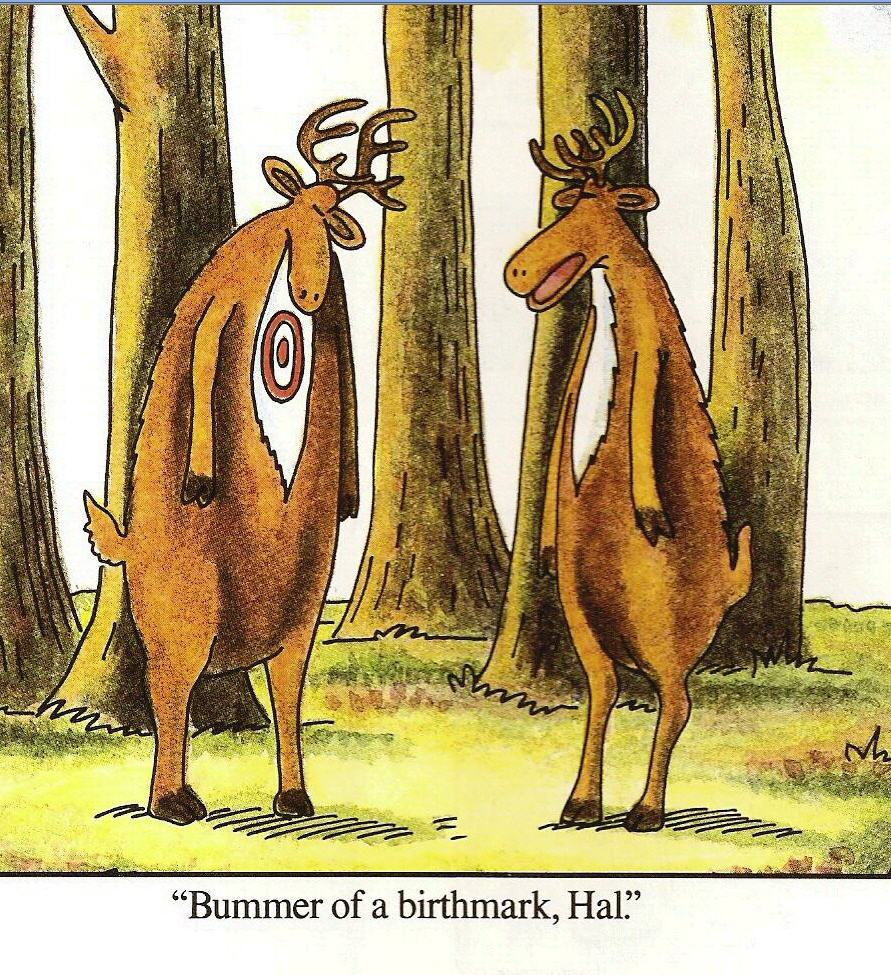
The Far Side, the single panel comic strip by Gary Larson, was another piece that had some pretty funny moments. One comic in 1986 that I distinctly remember was a panel showing two deer standing only on their hind legs facing each other. One deer has two concentric circles forming a target on his chest. The caption has the other deer saying, "Bummer of a birthmark, Hal."


As we press on into the twenty-first century, I find that more and more Christians are feeling the same way that deer felt. We can feel the frequency of attacks against Christian believers increasing faster than ever before. We see this most evidently in the recent best-selling works of the so-called "New Atheists," such as Richard Dawkins' The God Delusion, Sam Harris' Letter to a Christian Nation, and Christopher Hitchens' God is Not Great: How Religion Poisons Everything. These titles are now well-known and they've been extensively covered by popular media. However, I think that the prominence of these books is a comment on how our society has become more uncomfortable with a strong Christian faith.

It really seems as if we're entering a time where lines are being drawn more clearly. We live in a society that views belief as a deeply personal approach to life, and the most important thing to guide one's moral life. Yet most people also adopt a "salad-bar theology" in their beliefs; they think that they can pick and choose beliefs by what they like and don't like. If your plate looks different than mine, that's OK. Just so long as I can have only what I like1.

But we cannot be passive in the face of attack. In fact, the Bible commands us to engage with others in the war of ideas. We are the "always be prepared to give a defense to everyone who asks, yet with gentleness and reverence" as 1 Peter 3:15 tells us. That means we will need to be ready to have answers and face people who may seem pretty smart.

Think About It

How do you feel about what you believe? Is it only a personal choice or are there reasons why you believe what you do?

Pretty scary, huh? Well, don't be too worried. You're smarter than you think you are! You have the ability to give good, solid answers for the things you believe. You have just as much ability to stand up for your faith as anyone else—even the so-called experts. Then, why do most people get so flustered when objections or questions come their way? Well, primarily it's because they haven't ever taken the time to sit down and think through what it is they actually believe. But, as Christians, we're commanded to do just that!

Although many people want to shrink from such a command, I want to encourage you to move forward. Pick a topic, such as the existence of God. Study it. Read some of the good books, web sites and other materials that are already online. Checkout podcasts, like our weekly Come Let us Reason podcast.  It isn't as hard as you think. And it's crucial to remember just what's at stake.

You see, ideas have consequences. Believing what God says about people being made in His image caused advocates like William Wilberforce to rise up and demand the abolition of slavery. Believing that all human beings are precious powers the pro-life movement and has a direct impact on saving babies. It's not about trying to be some type of intellectual; it's about how knowledge affects the way we react to events as we see them. It means we're able to impact the world because we know things. We are fighting a spiritual war and souls hang in the balance. Let's fight smarter.

References

1. A Barna survey reports "74% to 23%—adults agreed that their religious faith was becoming even more important to them than it used to be as a source of objective and reliable moral guidance." The report also states "By a three to one margin (71% to 26%) adults noted that they are personally more likely to develop their own set of religious beliefs than to accept a comprehensive set of beliefs taught by a particular church." See "Christianity Is No Longer Americans' Default Faith", Barna Group Ltd. Jan 12, 2009. Online at http://www.barna.org/barna-update/article/12-faithspirituality/15-christianity-is-no-longer-americans-default-faith accessed 7-23-2009


Thursday, August 28, 2014

Blinding with Science

Frequently when I discuss issues of science as they relate to faith, I'm often told that science shouldn't be doubted. After all, science, unlike faith, isn't about what people want to believe. It only deals in cold, hard facts, and when science reaches a consensus, like it has with the modern neo-Darwinian paradigm, it is unreasonable to reject it. Rejecting the scientific beliefs of the vast majority of scientists is equal to denying that the earth is round.


That's the story, but that isn't science. It's scientism. Fundamental to science is the concept of questioning the facts we think we know, even what can be considered well-established facts. Newton's laws were thought to hold in all applications for centuries until quantum mechanics came along and threw a fly in the ointment. Other assumptions, such as the steady state model for the universe, have also been upended.

But many of those ideas are too esoteric for the average man on the street to really grasp. However, there is currently a paradigm shift happening in the health sciences that perfectly illustrates how accepted science can be flimsy, biased, and based not on facts but strong wills and politics. The story is fascinating and illustrates how just one man can create a belief that is so strong, it affects the viewpoint other experts, changes government regulations, and becomes an embedded belief by the general population.

In her article "The science of saturated fat: A big fat surprise about nutrition?" author Nina Teicholz summarizes her findings of a nine year investigation into the commonly-accepted belief that the more saturated fats you eat, the worse it is for your heart. I recommend you read the entire article, or if you would like even more detail, grab her well-documented book The Big Fat Surprise: Why Butter, Meat, and Cheese Belong in a Healthy Diet. However, here are a few quotes of how the myth of the unhealthy high fat diets became the unquestioned standard:

1. One man's assumption led to bad conclusions

Teicholz writes that the idea to link saturated fats to heart disease was proposed by Ancel Keys, a pathologist who was "an aggressive, outsized personality with a talent for persuasion."1  Keys' studies on this link "violated several basic scientific norms,"2 according to Teicholz.  For example, Key's findings were based on a single study, claiming to look at the diets of some 13,000 men across seven countries. However, Teicholz reports that Keys did not select random nations, but only those that supported his hypothesis, and he ignored others. She writes there were other problems with the study as well:
Due to difficulties in collecting accurate nutrition data, Keys ended up sampling the diets of fewer than 500 men, far from a statistically significant sample. And the study's star subjects — men on the Greek island of Crete who tilled their fields well into old age and appeared to eat very little meat or cheese — turned out to have been partly sampled during Lent, when the study subjects were foregoing meat and cheese. This must have led Keys to undercount their saturated-fat consumption. These flaws weren't revealed until much later. By then, the misimpression left by the erroneous data had become international dogma.3

2. One man's push led to accepted dogma

The second factor that led to the widespread acceptance of Keys views was a combination of good timing and Keys' dominant personality. Teicholz reports:
He found a receptive audience for his "diet-heart hypothesis" among public-health experts who faced a growing emergency: heart disease, a relative rarity three decades earlier, had skyrocketed to be a leading cause of death. Keys managed to implant his idea into the American Heart Association and, in 1961, the group published the first-ever guidelines calling for Americans to cut back on saturated fats, as the best way to fight heart disease. The US government adopted this view in 1977 and the rest of the world followed.4
Once the idea became ingrained, it became a foregone conclusion.
There were subsequent trials, of course. In the 1970s, half a dozen important experiments pitted a diet high in vegetable oil — usually corn or soybean, but not olive oil — against one with more animal fats. But these trials had serious methodological problems: some didn't control for smoking, for instance, or allowed men to wander in and out of the research group over the course of the experiment. The results were unreliable at best…

When Ronald M Krauss decided, in 2000, to review all the evidence purporting to show that saturated fats cause heart disease, he knew that he was putting his professional career at risk. Krauss is one of the top nutrition experts in the United States, director of atherosclerosis research at Children's Hospital Oakland Research Institute and adjunct professor of nutritional studies at the University of San Francisco at Berkley. But challenging one of his field's most sacrosanct beliefs was a near-heretical act.

Challenging any of the conventional wisdom on dietary fat has long been a form of professional suicide for nutrition experts. And saturated fats, especially, are the third rail.

3. The power of intimidation affects consensus

Finally, Teicholz states that Keys himself was not as interested in advancing the science as he was in keeping his findings in the center of belief. He would belittle and mock those who would oppose his theory:
Keys aggressively criticised these observations, which were like missiles aimed at the very heart of his theory… In response to a prominent Texas A&M University professor who wrote a critique of Keys, he said that the paper "reminds one of the distorting mirrors in the hall of jokes at the county fair".

Rolling over the opposition by sheer force of will was typical of Keys and his acolytes in defending their saturated-fat hypothesis. Keys was "tough and ruthless and would argue any point", Oliver, a prominent opponent, said. Since Keys's allies controlled so many top government health posts, critics were denied research grants and key posts on expert panels. As retribution for defending the healthiness of eggs, despite their cholesterol content, Oliver was publicly branded by two of Keys's main allies as a "notorious type" and a "scoundrel" because "he opposed us on everything".

In the end, Keys and his colleagues prevailed. Despite contrary observations from India to the Arctic, too much institutional energy and research money had already been spent trying to prove Keys's hypothesis. The bias in its favour had grown so strong that the idea just started to seem like common sense.5
The parallels between this and modern paradigms like global climate change or neo-Darwinian synthesis are striking. Each was formed at the right time by those looking to dismiss a creator or in a time of significant environmental sensitivity. Each has had high-profile proponents. Each has claimed the scientific high ground to the degree that any deviation from the accepted consensus would be mocked and belittled, and considered professional suicide.

Many good scientists would speak authoritatively on the saturated fat-heart disease link, even today. However, the consumer needs to be more dubious of any connection between the two. While many Keys's critics gained some clout by having a well-respected journal (the Lancet and the British Medical Journal) willing to publish their work, and thus began to crack the saturated fat myth, one wonders how long it would have persisted if the British medical professionals had not investigated the claims.

The tale of saturated fat and Ancel Keys should serve as a warning to those who claim that "consensus" and "accepted science" are good enough to keep scientific claims from being questioned. They show exactly the opposite. After all, scientists are people, and people are prone to be biased. So, don't accept the tale that science is above reproach. It can be a flawed belief system, too.


References

1. Teicholz, Nina. "The Science of Saturated Fat: A Big Fat Surprise about Nutrition?" The Independent. Independent Digital News and Media, 26 Aug. 2014. Web. 28 Aug. 2014.
2. Teicholz, ibid.
3. Teicholz, ibid.
4. Teicholz, ibid.
5. Teicholz, ibid.

Wednesday, August 27, 2014

Why Didn't God Create a World Where Everyone Would Go to Heaven?

Christianity teaches that God is all powerful, all knowing, and all loving. However, it also teaches that salvation is exclusively through Jesus and God "is not wishing for any to perish, but for all to come to repentance"(2 Pet. 3:9). If God has all knowledge, He would know that certain people will choose not to follow Him. Yet he creates these people anyway, resulting in  many souls being lost. Why would He create such a world? Wouldn't He look through all possible worlds He could have created and chosen to create one where everyone is saved?


I have argued elsewhere that hell is a logical result of a person choosing not to follow Christ. So, the assertion shouldn't be stated "why does God send anyone to hell", but rather "why wouldn't God create a world where all people choose Him and are saved".

Now, we know that God created us with the freedom to choose His ways or our own ways1. People are condemned to hell because they reject the righteous ways of God and seek their own pleasures (ref: Rom. 3:12, Matt:7:14). William Lane Craig asserts this when he writes, "People who are damned are so because they willingly reject God's grace and ignore the solicitation of His Spirit."2

Logical Limitations of God

The assertion above, though, assumes that there could exist such a world where everyone is saved and that world would suit God's purposes. This isn't necessarily so.

God is omnipotent (all powerful), but it is well recognized that omnipotence does not include performing that which is logically contradictory. In other words, to ask if God can make a rock so big that He can't lift it is nonsense. It's not a lack of omnipotence.

Similarly, it may not be logically possible for God to create a world where a significant number of people exist, all people are given freedom of choice, and all people choose to be saved. Dr. Craig writes "For God's ability to actualize worlds containing free creatures will be limited by which counterfactuals of creaturely freedom are true in the moment logically prior to the divine decree."3 Since truly free people have the ability to reject God, there may be no possible world where everyone freely accepts Christ's atonement. If that is true, then it is illogical to demand that God make such a world that can't exist.

Choosing Between Possible Worlds

But, even if some world is possible where everyone chooses salvation, it is also possible that the total number of individuals is so small that an all-loving God would choose to create another. Craig continues:
Suppose that the only worlds feasible for God in which all persons receive Christ and are saved are worlds containing only a handful of persons. Is it not at least possible that such a world is less preferable to God than a world in which great multitudes come to experience His salvation and a few are damned because they freely reject Christ? Not only does this seem to me possibly true, but I think that it probably is true. Why should the joy and blessedness of those who would receive God's grace and love be prevented on account of those who would freely spurn it? An omnibenevolent God might want as many creatures as possible to share salvation; but given certain true counterfactuals of creaturely freedom, God, in order to have a multitude in heaven, might have to accept a number in hell.4
Here Craig shows how it is not contradictory to believe that an all-loving and all powerful God could create a world where many people are not saved. As Craig points out, it is entirely possible that God would want to bestow His grace to as many as possible - not merely a handful. It is not out of the realm of possibility that certain free persons exist who—no matter what the circumstance—would simply never choose to follow Christ.

God, Salvation, And This World

Craig argues what God has done is bring into reality a world that maximizes the number of people who are saved while minimizing the number of people who are lost. He states "it is possible that God wants to maximize the number of the saved: He wants heaven to be as full as possible. Moreover, as a loving God, He wants to minimize the number of the lost: He wants hell to be as empty as possible. His goal, then, is to achieve an optimal balance between these, to create no more lost than is necessary to achieve a certain number of the saved. But it is possible that the balance between the saved and lost in the actual world is such an optimal balance.

"...It is possible that the terrible price of filling heaven is also filling hell and that any other possible world which was feasible for God the balance between saved and lost would be worse."5

Ultimate Ends

So, it is possible that if God were to create any world at all, the one in which we live contains an optimum balance between the saved and lost. An objector may counter "then God shouldn't have created anyone at all". However, this ignores the fact that people do choose their actions. It isn't reasonable to say that some shouldn't enjoy eternal life with God because others will willingly choose to rebel against Him. God is not responsible for those individuals rebelling, even if He knew they would before they were ever created.

References

1. See the article "Does Man Have Free Will?" at http://www.comereason.org/free-will.asp
2. Craig, William L. "Middle Knowledge and Christian Exclusivism." Sophia 34 (1995): 120-139.
http://www.reasonablefaith.org/middle-knowledge-and-christian-exclusivism
3. Craig, William L. "'No Other Name': A Middle Knowledge Perspective on the Exclusivity of Salvation through Christ". Faith and Philosophy 6. (1989): 172-88.
http://www.reasonablefaith.org/no-other-name-a-middle-knowledge-perspective
4. Ibid.
5. Ibid.
Come Reason brandmark Convincing Christianity
An invaluable addition to the realm of Christian apologetics

Mary Jo Sharp:

"Lenny Esposito's work at Come Reason Ministries is an invaluable addition to the realm of Christian apologetics. He is as knowledgeable as he is gracious. I highly recommend booking Lenny as a speaker for your next conference or workshop!"
Check out more X